How to Make Your Home Sustainable: A Complete Guide to Eco-Friendly Living in 2026
- Dean Rusk Delicana
- May 5
- 9 min read

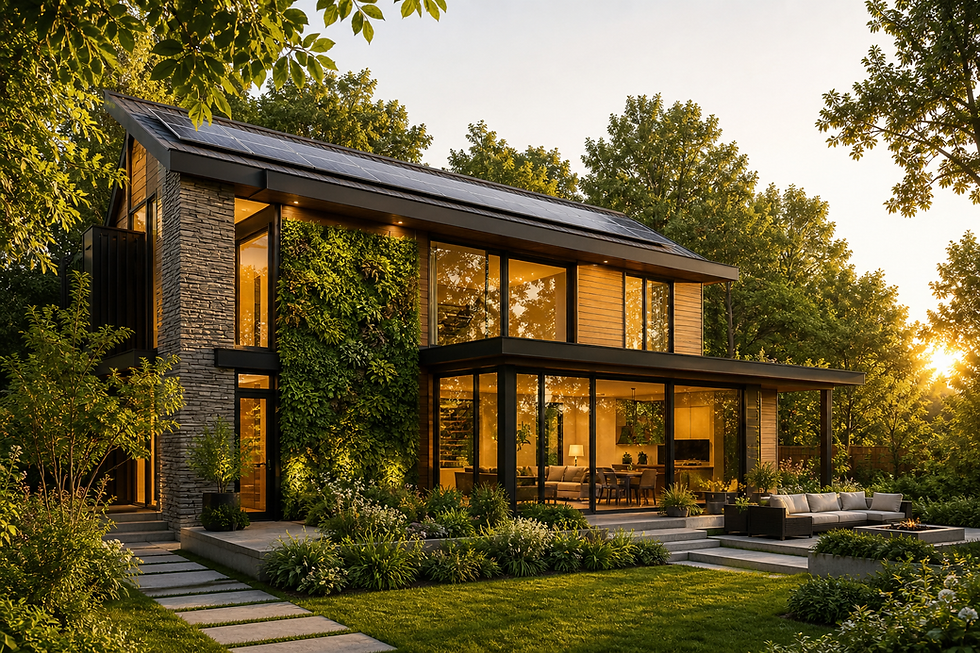
Your home has the power to either harm the planet or help heal it. Here is everything you need to know about sustainable housing — what it is, why it matters, how to achieve it, and homes around the world that are already showing us the way.
What Is a Sustainable Home?
A sustainable home is one that efficiently preserves resources, optimizes energy and water consumption, and is built to endure longer through the use of high-quality systems and materials. It is not just about recycling bins and reusable bags — it is a whole-house philosophy that touches everything from the walls around you to the habits you keep every day.
By its nature, sustainable architecture is forward-looking. It goes beyond green initiatives focused primarily on the current environment, to consider the broader principles of long-term social responsibility and economic viability — including life-cycle assessment, social equity in construction, resilience to climate change, and fostering healthy indoor environments.
In short, a sustainable home is one that takes care of its occupants without taking more from the Earth than it gives back.
Why Does Home Sustainability Matter?
The numbers are hard to ignore. Buildings and construction generate 37% of global carbon emissions, with residential structures contributing significantly (UNEP Global Status Report, 2020). That means the places where we sleep, eat, and raise our families are among the most consequential contributors to climate change.
An environmentally friendly home is designed, operated, and maintained in ways that reduce its carbon footprint and energy needs — and cutting down on energy use also helps save on utility bills. In the United States alone, more than 3.4 million families benefited from $8.4 billion in tax credits in 2023 to help lower the costs of clean energy and energy-efficient home upgrades (U.S. Department of the Treasury).
Beyond financial savings, green living physically decreases stress and enhances quality of life. The emphasis on cohesive design, lower expenses, and simpler systems that benefit the entire community leads to a happier and more satisfying lifestyle.
The case for sustainability is not just environmental — it is personal, financial, and social all at once.
Specific Ways to Make Your Home More Sustainable
You do not need to rebuild your house from the ground up. Many of the most impactful changes are surprisingly accessible. Here are ten key strategies, from structural upgrades to simple daily habits.
1. Prioritize High-Performance Insulation
Before you think about solar panels or smart gadgets, start with your building envelope. Heating and cooling your home accounts for a huge chunk of your energy use, and yet it is one of the easiest areas to improve. Modern eco-friendly insulation materials — such as sheep's wool, cork, or recycled denim — keep warmth in during winter, heat out in summer, and cut energy costs, all while being gentler on the environment than traditional fiberglass options. Properly insulated walls, roofs, and floors can transform the comfort of your home and leave both your wallet and your conscience lighter.
2. Install Solar Panels
Solar panels generate electricity that can be used to power your entire home. They are an excellent choice for producing clean energy with fewer carbon emissions. Home battery storage systems have also become increasingly affordable, with costs declining by 89% from 2010 to 2023, making residential energy storage economically viable for many homeowners. Modern sustainable homes now strive to achieve net-positive energy status — producing more energy than they consume over the course of a year.
3. Switch to LED Lighting
LED bulbs use 85% less power for the same light output compared to standard lighting. They are extremely energy-efficient, producing less heat while generating more light at a lower ongoing cost. This is one of the simplest, most affordable changes any homeowner can make today, and the savings compound over years of use.
4. Use Energy-Efficient Appliances
Energy-efficient appliances lower your home energy costs while simultaneously minimizing greenhouse gas emissions and water usage. When replacing old appliances, look for ENERGY STAR-certified products — from refrigerators and washing machines to dishwashers and water heaters. The upfront cost difference is often recovered within a few years through reduced utility bills.
5. Invest in Water Conservation Systems
Rainwater harvesting systems can be positioned and sized to maximize water collection based on your home's roof design and orientation. Even simpler measures — low-flow showerheads, dual-flush toilets, and turning off the tap while brushing your teeth — can meaningfully reduce household water consumption. Small behavioral shifts, practiced consistently, produce significant results over time.
6. Choose Eco-Friendly Paints and Building Materials
Chemical-based paints contain hazardous compounds that affect both human health and the surrounding environment. Eco-friendly paints use water-based solvents that reduce or completely eliminate the discharge of volatile organic compounds (VOCs) into your living spaces. They have no harsh odor and a substantially lower environmental impact. The same principle applies to flooring, countertops, and adhesives — choosing low-VOC, recycled, or responsibly sourced materials makes a meaningful difference to indoor air quality and ecological footprint alike.
7. Create a Sustainable Garden
An energy-efficient garden uses less water. Using mulch generously around plants retains moisture and reduces the need for frequent watering. Native plants require far less irrigation and no chemical fertilizers, as they are already adapted to the local climate. Composting kitchen and garden scraps instead of sending them to landfill keeps organic waste out of the waste stream while enriching your soil naturally — a closed-loop system right in your backyard.
8. Go Paperless and Reduce Household Waste
Moving toward a paperless home clears clutter and cuts back on unnecessary consumption. Scanning, saving, and sharing documents digitally eliminates the ongoing demand for paper and the associated deforestation. Pair this with switching to cloth shopping bags, reusable water bottles, and bar soap instead of plastic-bottled products to systematically cut single-use plastic from your daily routines.
9. Explore Geothermal Heating and Cooling
Geothermal systems use the stable temperature of the earth beneath your home to heat and cool your living spaces at a fraction of typical energy costs. Advanced drilling techniques have reduced installation costs by approximately 25 to 35% compared to conventional systems in recent years, making this technology more accessible than ever before. For homeowners in regions with extreme seasonal temperatures, geothermal systems deliver exceptional long-term returns on investment.
10. Embrace Biophilic Design
Biophilic design brings natural elements — plants, natural light, organic materials, and water features — into your living environment. It improves indoor air quality, reduces psychological stress, and strengthens your daily connection to the natural world. Incorporating a living wall of plants, maximizing natural light through larger windows, or choosing wood and stone finishes over synthetic materials are all accessible ways to bring this principle into any home, at any budget level.
Inspiring Examples of Sustainable Homes Around the World
The best evidence that sustainable living is achievable — and beautiful — comes from homes that have already made it a reality. Here are some of the world's most compelling examples.
1. FP 10 | Southampton House — Southampton, USA (BuildLabs)
This modern three-story residence in Southampton, New York, is a masterclass in integrating luxury with ecological responsibility. The home features solar panels, smart home energy management devices, and an open floor plan that seamlessly merges indoor and outdoor living spaces. Energy-efficient, triple-pane windows flood every room with natural light while dramatically reducing heat loss. The exterior is clad in unique stained cedar, which adds warmth and natural character to the otherwise contemporary structure. This home demonstrates that a high-performance, eco-conscious design need not sacrifice the comforts or aesthetics of modern living.
2. Holmberg House — Belgrano, Argentina (Estudio Borrachia)
The Holmberg House in Belgrano, Buenos Aires, is one of the most visually inventive sustainable homes in the world. Its façade resembles a radiator — a network of exposed pipes that circulate water from two rooftop storage tanks throughout the entire structure. This system serves a dual purpose: delivering water to the home's occupants while simultaneously irrigating a lush layer of plant growth across the building's exterior, creating microclimates that cool the structure naturally and support urban biodiversity. The Holmberg House is proof that a building's infrastructure can itself become a living, breathing ecosystem.
3. Living Screen House — Sydney, Australia (CPlusC Architects + Builders)
Winner of the 2018 Good Design Award, the Living Screen House in Sydney is a landmark in sustainable residential design. Its distinctive wooden grid façade — filled with windows and perforated metal panels — allows generous natural light to fill every corner of the home. Throughout the interior, self-maintained green living wall screens, illuminated by energy-efficient LED systems, purify the air and connect residents to nature without leaving home. Smart systems continuously monitor energy use, rooftop solar panels generate clean electricity, and an integrated water collection and reuse system ensures nothing is wasted. The Living Screen House sets a high bar for what thoughtful, technology-integrated eco-design can look like.
4. Đai Kim House — Hanoi, Vietnam (Aline Architect)
In the dense urban heat of Hanoi, the Đai Kim House solves a fundamental problem with an elegant architectural answer: passive ventilation. The home's striking façade is specifically engineered to maximize natural airflow throughout the structure, keeping interior temperatures comfortable without relying on energy-intensive air conditioning systems. Beyond its functional brilliance, the home's visually interesting design elements challenge the architectural monotony common in dense Vietnamese cities, proving that climate-responsive design and aesthetic ambition are not at odds with one another. The Đai Kim House is a reminder that some of the most sustainable solutions are also the most beautifully simple.
5. HA 60 | Sag Harbor House — Sag Harbor, USA (BuildLabs)
In the heart of Sag Harbor's historic district on Long Island, this project reframes sustainability through the lens of restoration rather than new construction. Rather than demolishing an aging structure, BuildLabs preserved and reimagined the original building, extending it seamlessly into a stylish pool cabana that complements both the home's character and the surrounding neighborhood. This approach embodies a crucial but often overlooked principle of sustainable building: the most environmentally responsible structure is frequently the one that already exists. By choosing renovation over demolition, this project avoided the carbon cost of new materials, new foundations, and construction waste.
6. Passive House — Frankfurt, Germany
Germany has been a global leader in the Passive House movement, a rigorous building standard that requires structures to use up to 90% less energy for heating and cooling compared to conventional construction. Passive Houses in Frankfurt achieve this through airtight building envelopes, triple-glazed windows, super-insulated walls, heat recovery ventilation systems, and strategic south-facing orientation to maximize passive solar gain. There are no conventional boilers or air conditioning units — the building itself does the work of climate control. What was once considered an experimental niche is now widely regarded as the gold standard for new residential construction across Europe.
7. Net-Zero Home — British Columbia, Canada
Canada's Pacific Northwest has become a proving ground for net-zero residential construction — homes that produce as much clean energy as they consume over the course of a year. In British Columbia, net-zero homes combine rooftop solar arrays, high-performance insulation, triple-glazed windows, and heat pump technology to achieve energy balance even in cooler northern climates. These homes demonstrate that net-zero living is not a warm-weather luxury — it is an achievable standard anywhere in the world, given the right design approach and commitment to performance.
Your Home, Your Planet: A Call to Action
The transformation toward sustainable living does not require a total reinvention of your life. Making your home more sustainable is about weaving smarter choices into the rhythm of daily life — one decision at a time. The walls around you, the habits you keep, even the soil outside your door all hold the potential to shrink your footprint and elevate your living experience.
Start with one change. A pack of LED bulbs. A low-flow showerhead. A compost bin in the kitchen. Then let each small step build the confidence and momentum for the next. Whether you are a renter making simple swaps, a homeowner planning your next renovation, or someone building from the ground up, there is a version of sustainable living that fits your life right now.
The homes profiled above — from Argentina to Australia, from Vietnam to the American coast — are proof that sustainable housing is not a distant ideal reserved for architects and environmentalists. These homes are being built, lived in, and loved today by real families who chose to do things differently.
Every home that chooses sustainability makes the next one a little easier, a little cheaper, and a little more possible. The planet does not need a handful of perfect homes. It needs millions of homes that are trying.
Your home is where your life happens. Make it a place the planet can be proud of, too.
Want to Bring This Into Your Classroom?
Teaching kids that their daily habits matter is one of the most powerful things you can do as an educator. But a lesson this layered deserves more than a last-minute plan.
We put together a complete 5-day unit so you don't have to start from zero. Scripts, worksheets, rubrics, visual aid prompts — everything is inside, structured, and ready to go.
Your students get: hands-on activities, a real seed to plant, an upcycling project, and a personal pledge they write themselves. A week they will actually remember.
You get: your evenings back.
👉 Grab the full unit on Payhip and teach it as early as this week.
Related Articles:
References
Gauci, T. (2026). Sustainable Houses: A Smarter Way to Eco-Friendly Living in 2025. Beyond The Urban. https://beyondtheurban.com/sustainable-houses-eco-friendly-living/
Living Green Technology. (2025). Sustainable Living at Home: Practical Steps for Homeowners. https://www.livinggreentechnology.org/sustainable-living-at-home-practical-steps-for-homeowners/
The PHD Team. (2025). 10 Surprisingly Simple Ways to Make Your Home Sustainable. Passion Home Design. https://passionhomedesign.com/10-surprisingly-simple-ways-to-make-your-home-sustainable/
Nesbit, J. (2025). 10 Ways To Make Your Home Environmentally Friendly. U.S. News & World Report. https://realestate.usnews.com/real-estate/articles/how-to-make-your-home-environmentally-friendly
NBC News Select. (2025). 7+ Easy At-Home Sustainability Swaps for an Eco-Friendly Lifestyle. https://www.nbcnews.com/select/shopping/best-sustainable-swaps-fwiw-podcast-rcna343076
Carrillo, H. (2024). 101 Sustainability Tips & Ideas For A Greener Lifestyle. Sustainable Jungle. https://www.sustainablejungle.com/sustainability-tips/
Homes and Gardens. (2024). 9 Ways to Be Sustainable at Home. https://www.homesandgardens.com/interior-design/sustainable-at-home
Nielsen, J. (2024). 7 Stunning Examples of Sustainable and Eco-Friendly Homes Around the World. BuildLabs. https://www.buildlabs.com/blog/best-examples-eco-friendly-homes-around-world
Arch2O. (2024). 14 Sustainable Houses You Would Love to Live In. https://www.arch2o.com/sustainable-houses/


Comments