Sustainable Design: 10 Buildings That Are Changing Architecture Forever
- Dean Rusk Delicana
- May 3
- 15 min read

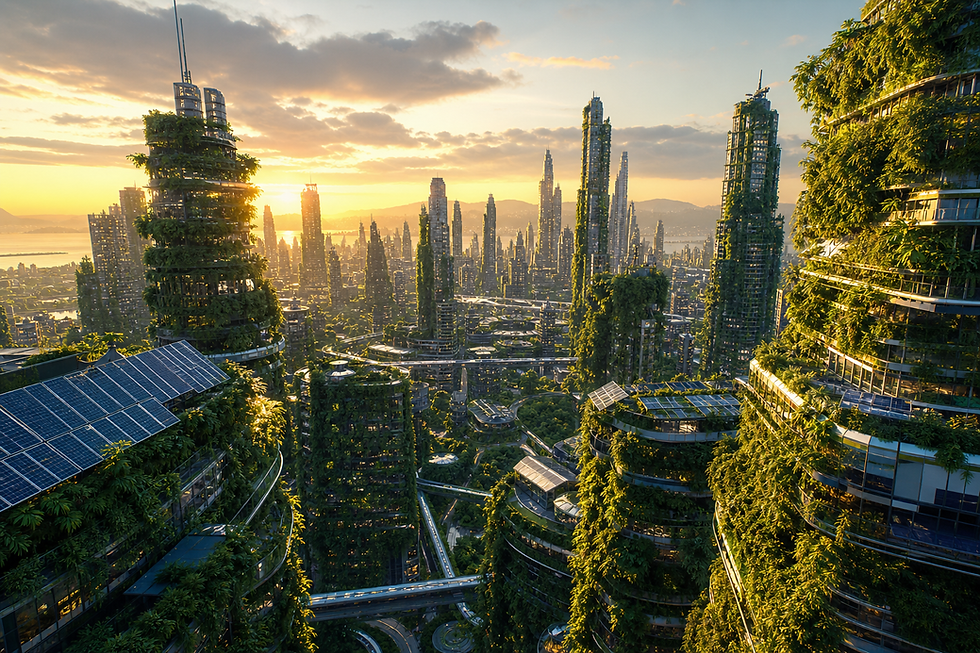
What Is Sustainable Design — and Why Is It Urgent Right Now?
Sustainable design is one of the most consequential ideas in architecture today — and one of the most misunderstood. At its core, sustainable design is the practice of creating structures that meet present human needs without compromising the ability of future generations to meet theirs. In the built environment, this translates into buildings that minimize energy consumption, reduce carbon emissions, conserve water, use responsibly sourced materials, and actively support ecological health.
This is not simply about adding solar panels to a rooftop or planting greenery in a lobby. True sustainable design embeds environmental responsibility into every decision — from the orientation of a building on its site, to the embodied carbon in its concrete, to the way it manages stormwater decades after construction.
The urgency has never been greater. The built environment is responsible for nearly 40% of global energy-related carbon dioxide emissions. Construction consumes vast quantities of raw materials, much of which ends up as waste. Urban heat islands are intensifying as cities expand with heat-absorbing concrete and glass. Meanwhile, global temperatures continue rising, extreme weather events are growing more frequent, and biodiversity is declining at an alarming rate.
Sustainable architecture responds to this crisis with ingenuity rather than despair. It asks: what if a building could produce more energy than it uses? What if a skyscraper could host an entire forest? What if a public facility could sustain itself entirely on rainwater and sunlight? The buildings profiled in this article prove these are not hypothetical questions — they are built realities, standing in cities across the world, demonstrating that beauty, function, and ecological responsibility can coexist in extraordinary ways.
The effects of sustainable design ripple far beyond individual buildings. Green buildings improve air quality in surrounding neighborhoods, reduce strain on municipal energy grids, lower operating costs for tenants, and boost the mental and physical well-being of occupants. Biophilic design — the intentional integration of natural elements, materials, and processes — has been shown through repeated research to reduce stress, increase productivity, and improve overall satisfaction with built spaces. When a building like the ones below opens its doors, it shifts the cultural conversation about what architecture is allowed to demand of the environment — and what the environment has a right to demand back from architecture.
For designers, developers, and anyone interested in where the built world is headed, these ten structures offer not just inspiration but a practical curriculum in what high-performance, human-centered, planet-first architecture looks like in practice.
10 Green Architecture Examples That Are Rewriting the Rules of Sustainable Building
1. Bosco Verticale — Milan's Vertical Forest and Living Architecture Pioneer
Imagine living inside a forest. Not beside it, not overlooking it through a window — inside it, with branches reaching past your balcony and birds nesting a few feet from your bedroom. That is the everyday reality for residents of Bosco Verticale, the twin residential towers designed by Stefano Boeri Architetti that have become one of the most iconic examples of sustainable design in the 21st century.
Completed in 2014, the two towers rise 80 and 112 meters above Milan's Porta Nuova district. Their most astonishing feature is not their height but what covers them: over 480 medium to large trees, approximately 300 small trees, 5,000 shrubs, and 11,000 perennial plants cascading across their façades in a magnificent vertical ecosystem. The total plant life is equivalent to roughly two hectares of urban forest — compressed and elevated across the faces of two towers.
This living skin does remarkable environmental work. The vegetation absorbs CO₂ and produces oxygen, significantly improving air quality in the surrounding neighborhood. The plants act as a natural thermal buffer, shading apartments in summer and allowing sunlight through in winter, which reduces energy demand for heating and cooling. Smart irrigation systems fed by filtered greywater keep the greenery alive without placing undue demand on the city's water supply. The towers also attract birds, butterflies, and insects, creating a genuine urban wildlife corridor in the heart of one of Europe's busiest manufacturing cities.
Lesson learned: treat nature as architecture, not decoration
Nature is not an amenity to be added after the building is designed — it is a structural and environmental system that can be integrated from the very beginning. When vegetation is treated as architecture, it transforms both the building's performance and the quality of urban life around it.
2. The Edge — Amsterdam's Data-Driven Net-Zero Office Building
If Bosco Verticale is sustainable design expressed through nature, The Edge in Amsterdam is its technological counterpart — a building so sophisticated in its monitoring and optimization systems that it earned a BREEAM sustainability score of 98.36%, the highest ever recorded at the time of its construction and still among the highest in the world.
Completed in 2015 for Deloitte and designed by PLP Architecture, The Edge is a 15-floor office building widely called the world's smartest building. It is threaded with approximately 28,000 sensors that track light levels, temperature, humidity, movement, and occupancy in real time. This sensor network feeds a central management system that continuously adjusts lighting, ventilation, and heating to match actual human presence and need. On any given day, the building knows precisely which desks are in use, which spaces are empty, and exactly how much energy each zone requires.
The building draws thermal energy from a groundwater aquifer beneath the site, using heat pump technology for efficient climate control. Its south-facing atrium is glazed to capture passive solar heat in winter. Rooftop solar panels and a nearby solar field arrangement ensure the building produces as much or more electricity than it consumes over the course of a year — making it a genuine net-zero energy building.
Lesson learned: smart technology must be integrated, not retrofitted
Smart technology, when genuinely woven into a building's design rather than bolted on afterward, produces transformative efficiency gains. The Edge demonstrates that data-driven design is not a luxury reserved for technology companies — it is one of the most powerful tools available to any sustainable architect.
3. One Central Park — Sydney's Award-Winning Vertical Garden Tower
Sydney's skyline contains many impressive buildings, but One Central Park stands apart because it feels alive. Completed in 2013 and designed by celebrated French architect Jean Nouvel in collaboration with botanist Patrick Blanc, the development consists of a 34-story residential tower and a 12-story apartment building, their façades blanketed in what became — at the time of construction — the world's tallest vertical garden.
More than 35,000 individual plants drawn from over 350 species of Australian and exotic flora were arranged across 23 green walls covering approximately 50% of the building's exterior surface. The effect is breathtaking: a building that seems to be growing rather than simply standing. But the gardens are far more than decorative. They provide natural insulation, reducing solar heat gain and lowering the energy needed to cool the apartments inside. They improve air quality and support urban biodiversity in a dense inner-city neighborhood.
One of the project's most inventive features is its heliostat system — a pair of motorized, sun-tracking mirror arrays mounted at the top of the building that reflect natural sunlight down into the public park and courtyard below, which would otherwise be shaded by the towers' bulk for much of the year. The development also incorporates an advanced recycled water treatment plant that processes sewage on-site and uses the treated water to irrigate the vertical gardens, reducing freshwater consumption significantly. One Central Park received the World's Best Tall Building award from the Council on Tall Buildings and Urban Habitat in 2014.
Lesson learned: sustainable design and community design are inseparable
When a building actively improves the public realm around it — through sunlight redirection, green space, and cleaner air — it generates social value that extends far beyond its property boundary. The best eco-friendly buildings design for the city, not just for the site.
4. Bullitt Center — Seattle's Living Building and Net-Zero Water Pioneer
The Bullitt Center does not merely aspire to be green. It aspires to be a living building — a structure that operates with the self-sufficiency and closed-loop efficiency of a natural ecosystem. Opened on Earth Day in 2013, this six-story, 4,600-square-meter commercial building in Seattle's Capitol Hill neighborhood is frequently described as the greenest office building in the world, and the claim is difficult to dispute.
The building was designed to meet the rigorous standards of the Living Building Challenge, one of the most demanding green building certification frameworks in existence. It generates 100% of its electricity from a 575-panel rooftop solar array. It collects and purifies all of its water from rainfall, eliminating any connection to the municipal supply for potable needs — making it a genuine net-zero water building. Composting toilets process all human waste on-site, with no sewage discharged to the city system.
The building was designed for a 250-year lifespan — an almost unheard-of commitment in commercial construction — and built entirely without the hundreds of toxic chemicals, including PVC, BPA, and a range of flame retardants, commonly found in conventional office environments. The design drew deliberate inspiration from Seattle's old-growth Douglas Fir forests, aiming to replicate the ecological intelligence of those ecosystems: capturing resources, cycling waste into nutrients, generating all needed energy on-site, and doing so with extraordinary longevity.
Lesson learned: set targets that seem impossible, then engineer your way there
The boldest sustainable buildings set radical benchmarks and then meet them. The Bullitt Center proves that net-zero energy, net-zero water, and net-zero waste are not utopian ideals — they are practical design specifications achievable today, in an ordinary urban location, within a realistic commercial construction budget.
5. ACROS Fukuoka — Japan's Terraced Green Building That Multiplied Urban Parkland
When the city of Fukuoka needed a large administrative and cultural center in the 1990s, it faced a dilemma familiar to cities everywhere: the best available site was adjacent to one of the city's few remaining public parks, and building on it would mean sacrificing precious green space. The solution delivered by Argentine architect Emilio Ambasz was radical, elegant, and deeply instructive: put the park on top of the building.
Completed in 1995, ACROS Fukuoka — the Asian CrossRoads Over the Sea international hall — presents one face to the city as a conventional glass curtain-wall tower. But on the side facing Tenjin Central Park, the building steps upward in a series of terraced levels, each planted with a lush garden. The result is a stepped green mountain rising 60 meters above street level, comprising over 37,000 plants from 76 different species spread across roughly 15 planted terraces.
Rather than removing parkland from the city, ACROS Fukuoka multiplied it. The green terraces provide habitat for birds and insects, reduce urban heat island effects, insulate the building, and manage stormwater runoff. They are publicly accessible, drawing visitors who climb the planted hillside as they might a natural landscape. Inside, the building houses a symphony hall, international conference facilities, retail spaces, and government offices — all benefiting from the thermal buffer provided by the living exterior.
Lesson learned: a building's surface is a potential ecological resource
Sustainable design sometimes requires reimagining what a facade can be. ACROS Fukuoka showed that urban development and urban green space are not necessarily in competition — provided architects are willing to think three-dimensionally and treat every surface as an opportunity.
6. Pixel Building — Melbourne's First Carbon-Neutral Office and Material Innovation Showcase
Small in footprint but enormous in ambition, Melbourne's Pixel Building punches far above its weight in the world of sustainable architecture. Completed in 2010 by Studio 505, this four-story commercial building was Australia's first carbon-neutral office building — generating every kilowatt of its electricity and every liter of its water entirely on-site.
The building's most immediately striking feature is its colorful façade, composed of panels in vivid shades of orange, green, yellow, and blue. These are not merely decorative. The panels are precisely engineered to optimize shading for the interior spaces, controlling solar heat gain while maximizing natural daylight. Behind this expressive exterior sits an impressive array of sustainability technologies: solar photovoltaic panels, small wind turbines, an anaerobic digester that processes organic waste into biogas, vacuum toilets that use a fraction of the water of conventional systems, and a rainwater harvesting and filtration system that supplies all potable water needs.
One of the Pixel Building's most significant contributions to sustainable construction is Pixelcrete — a specially developed concrete mix formulated to contain roughly half the embodied carbon of standard concrete. Given that conventional concrete production accounts for approximately 8% of global CO₂ emissions, this material innovation has implications far beyond a single building. The Pixel Building achieved a perfect score of 105 Green Star points — the first building in Australia to do so — and holds LEED Platinum certification.
Lesson learned: material innovation is one of sustainable design's most important frontiers
Building size is no excuse for low sustainability ambition. The Pixel Building demonstrates that even a modest commercial structure can achieve radical self-sufficiency, and that rethinking construction materials — particularly concrete — is among the highest-impact changes the industry can make.
7. Powerhouse Brattørkaia — Norway's Energy-Positive Office Building in a High-Latitude Climate
In most cities, office buildings are consumers of the energy grid. In Trondheim, Norway, one office building is a net producer. Powerhouse Brattørkaia, completed in 2019, is an energy-positive building — meaning it generates more electricity over its entire lifetime than was consumed during its construction, operation, and eventual demolition combined. This is one of the most demanding energy benchmarks a building can achieve.
In Trondheim, a city that sits at 63 degrees north latitude and receives limited sunlight for much of the year, reaching this standard is a remarkable feat of passive building design and renewable energy integration. The building's roof is almost entirely covered by approximately 3,000 square meters of solar panels, generating around 485,000 kilowatt-hours of electricity annually. The building is shaped to maximize the panels' exposure, with a broad, south-tilted roofline that captures as much of Trondheim's limited winter light as possible.
During summer months, the building produces a significant electricity surplus that is fed back into the local grid, compensating for reduced production in winter. A seawater heat exchange system provides efficient heating and cooling, and the façades are heavily insulated to minimize heat loss through harsh Norwegian winters. The architects, Snøhetta, designed every aspect of the building — orientation, massing, window-to-wall ratio, insulation thickness, material choices — around the singular objective of energy positivity.
Lesson learned: climate is a design parameter, not an obstacle
Powerhouse Brattørkaia proves that even in high-latitude, low-sunlight environments, buildings can become net contributors to the energy grid. Passive building design and renewable energy generation are not alternatives — they must be engineered to work together from day one.
8. California Academy of Sciences — San Francisco's Living Roof and Passive Ventilation Landmark
Science museums are often built to showcase discoveries about the natural world. The California Academy of Sciences, designed by Renzo Piano and completed in 2008 in San Francisco's Golden Gate Park, goes one step further: the building itself is a living scientific experiment in green architecture.
The Academy's most celebrated feature is its undulating living roof — a 10,000-square-meter expanse of native California plants planted across a topographically varied surface of hills and valleys that mirror the natural landscape of the surrounding park. The living roof serves multiple ecological functions simultaneously. It insulates the building, significantly reducing energy demand for climate control. It retains and filters stormwater, releasing it slowly rather than sending it rushing into the city's drainage system. It provides habitat for native insects and birds, and its light colors and vegetation help combat the urban heat island effect that plagues dense city neighborhoods.
Inside the building, 60,000 photovoltaic cells are integrated into the overhanging roof canopy to generate solar electricity. The central atrium uses a system of 2.5-meter motorized skylights that open and close automatically to ventilate the space through passive convection, drawing warm air upward and out without any mechanical energy. Ninety percent of the Academy's occupied spaces receive natural daylight, dramatically reducing artificial lighting demand. The building holds LEED Platinum certification and was constructed using over 90 million pounds of recycled steel.
Lesson learned: the roof is one of architecture's most underutilized ecological assets
When designed as a living, working environmental system — rather than simply a weather-proof lid — a roof can simultaneously insulate, generate energy, manage stormwater, support biodiversity, and cool the surrounding urban environment. It is perhaps the single highest-leverage surface in sustainable building design.
9. The Crystal — London's LEED Platinum and BREEAM Outstanding Sustainability Showpiece
Sitting on the southern bank of the Thames in London's Royal Docks, The Crystal is not merely a sustainable building — it is a dedicated monument to the idea of sustainable cities. Commissioned by Siemens and completed in 2012 by Wilkinson Eyre Architects, this striking crystalline structure houses one of the world's most comprehensive interactive exhibitions on the future of urban environments, attracting over 100,000 visitors each year.
The building is 100% electric, drawing no energy from fossil fuels whatsoever. Roughly 20% of its electricity needs are met by 1,580 square meters of solar photovoltaic roof panels. The remainder is drawn from the grid, with the building's advanced energy management systems ensuring consumption remains exceptionally low through a combination of ground source heat pumps, rainwater harvesting for toilet flushing and irrigation, and real-time monitoring and optimization. The Crystal holds both LEED Platinum and BREEAM Outstanding certifications — two of the most respected green building standards in the world — making it one of the most comprehensively certified sustainable buildings ever constructed.
What makes The Crystal particularly powerful as a piece of architecture is the congruence between its form and its function. A building dedicated to inspiring visitors to embrace sustainable urbanism should itself embody those principles without compromise. The Crystal does exactly that.
Lesson learned: buildings have the power to persuade as well as to perform
When a structure dedicated to environmental education is itself an exemplar of environmental best practice, it becomes more than a venue — it becomes a physical, inhabitable argument for the sustainable city. Architectural credibility and environmental credibility must go hand in hand.
10. Stockholm Wood City — The World's Largest Mass Timber Urban Development
The most ambitious entry on this list is still taking shape — but its scale and vision make it essential to include. Stockholm Wood City, currently under development in the Sickla district of Stockholm, is planned to become the largest urban mass timber construction project in history. When complete, it will comprise approximately 7,000 apartments, 9,000 office spaces, and extensive retail and public areas across 25 city blocks — all built from engineered timber.
Mass timber — structural wood products such as cross-laminated timber (CLT) — represents one of the most promising frontiers in sustainable construction today. Wood sequesters carbon as it grows and continues to store that carbon when used as a structural material, rather than releasing it as steel and concrete production do. Mass timber construction generates dramatically less construction waste, can be prefabricated off-site for precision and efficiency, and creates warmer, more biophilic indoor environments that research consistently links to improved occupant well-being and productivity.
Stockholm Wood City also integrates broader sustainable urbanism principles: walkability is prioritized throughout the district, with human-scale streets and abundant public green space woven into the masterplan from the outset. Renewable energy systems and green infrastructure are embedded in every phase of development. The project is expected to welcome its first residents and workers by 2027, with full completion extending beyond 2030.
Lesson learned: sustainable design operates at the scale of the city, not just the building
Sustainable architecture is not only about individual structures — it is about the neighborhoods, districts, and cities those structures collectively create. Stockholm Wood City offers a vision of urban development in which the choice of material, the design of streets, and the provision of green space are understood as inseparable components of a single ecological strategy.
The Future of Sustainable Design: What Comes Next
The ten buildings described above are not outliers. They are the leading edge of a transformation accelerating across the entire construction industry — driven by regulatory pressure, material science breakthroughs, smart technology, and a rapidly shifting cultural understanding of what buildings owe the planet.
Regulatory pressure is intensifying everywhere. Governments across Europe, North America, and much of Asia are implementing mandatory carbon benchmarks for new construction, with passive house standards and net-zero energy requirements appearing in building codes with increasing frequency. The question for new construction is no longer whether to pursue sustainability but how quickly and how completely.
Material innovation is opening new possibilities. Mass timber, as Stockholm Wood City demonstrates, can replace steel and concrete in structures of considerable height and complexity. Low-carbon concrete formulations — like the Pixelcrete developed at Melbourne's Pixel Building — are reducing the embodied carbon of foundations and structural systems. Bio-based insulation materials, recycled-content façade panels, and reclaimed structural elements are moving from experimental to mainstream.
Technology is transforming what buildings can know about themselves. The sensor networks and artificial intelligence systems pioneered by The Edge in Amsterdam are becoming more affordable and more capable with each passing year. Buildings are increasingly able to communicate with the energy grid, modulating their consumption in response to renewable energy availability and adjusting their internal systems automatically to maintain occupant comfort with minimal energy waste.
Biophilic design is shifting from aesthetic preference to evidence-based practice. Research consistently demonstrates that occupants of buildings incorporating natural light, vegetation, natural materials, and views of nature report better health outcomes, lower stress levels, higher productivity, and greater satisfaction with their environments. Studies published in journals including Building and Environment continue to build the empirical case for integrating nature into architecture at every scale.
Perhaps most importantly, the cultural narrative around sustainable architecture is changing. For too long, green buildings were associated with sacrifice — with less comfort, less beauty, less architectural ambition offered up in service of environmental virtue. The buildings in this article dismantle that narrative completely. The Edge is stunning. Bosco Verticale is breathtaking. One Central Park is an architectural landmark. The Crystal is a showpiece. The Bullitt Center is a feat of engineering ingenuity.
The future of sustainable design is not a future of doing less. It is a future of doing more — more creatively, more intelligently, and with a far more sophisticated understanding of the relationship between the built environment and the living planet that sustains it. The buildings already standing show us exactly what is possible. The only remaining question is how quickly the rest of the world will follow.
🌿 Bring These Buildings Into Your Classroom
The 10 buildings in this article show students something powerful: that sustainable design is not a future fantasy — it is already happening in cities right now. The natural next step is helping them understand why these buildings matter and how they can think like the people who design them.
Our No-Prep 5-Day Lesson Plan on Sustainability in Cities is built for exactly that conversation. Designed for Grades 2–5, it uses real green buildings from New York and Toronto as visual examples to introduce sustainable architecture — solar panels, green roofs, natural materials, rainwater harvesting — before students design a green building of their own. The unit then expands into clean transportation, waste reduction, and a final project where students plan an entire sustainable city from scratch.
Every lesson includes a teacher script, student worksheet, visual aid description, and rubric. No prep. No research. No Sunday night scramble.
Instant download. Fully editable. Ready for Monday.
References
Parametric Architecture. Top 10 Examples of Most Sustainable Architecture in 2025. https://parametric-architecture.com/10-sustainable-architecture-around-the-world/
Sustainability Global. Top 10 Most Sustainable Buildings in the World (2025). https://sustainabilityglobal.org/sustainable-buildings-2025/
Sustainability Magazine. Top 10: Most Sustainable Buildings. https://sustainabilitymag.com/top10/top-10-most-sustainable-buildings-2025
A World to Travel. 18 of the World's Most Stunning Green Buildings. https://www.aworldtotravel.com/green-buildings-sustainable-architecture-worldwide/
The Constructor. The Top 10 Most Sustainable Buildings Around the World. https://theconstructor.org/architecture/the-top-10-most-sustainable-buildings-around-the-world/570080/
Architectural Digest India. World Environment Day: 21 Most Beautiful Sustainable Buildings in the World. https://www.architecturaldigest.in/story/world-environment-day-most-beautiful-sustainable-buildings-in-the-world/
Engineers and Architects of America. 20 Best Sustainable/Green Architecture Examples in the World. https://www.e-a-a.com/20-best-sustainable-green-architecture-examples-in-the-world/


Comments