How to Reduce Food Waste at Home: Causes, Effects, and Solutions
- Dean Rusk Delicana
- May 2
- 12 min read

What Is Food Waste?
Open the refrigerator, and you are likely to find a forgotten bag of wilting spinach, leftovers no one went back for, or a block of cheese that quietly expired last week. These small moments feel harmless in isolation — but they add up to one of the most consequential environmental and economic crises of our time.
Food waste refers to any food that is discarded or lost at any point in the supply chain, from the farm to the factory to your kitchen bin. At the household level, it typically means groceries that spoil before use, leftovers that never get eaten, and produce that gets tossed because it looks a little "off."
Understanding what food waste is — and where it comes from inside your own home — is the essential first step toward doing something about it.
How Much Food Do Households Waste?
The scale of household food waste is far larger than most people realize. According to Feeding America, 119 billion pounds of food are wasted in the United States every year — the equivalent of 130 billion meals, and nearly 40% of all food in the country. Globally, roughly one-third of all food produced for human consumption is lost or wasted each year — enough to feed billions of people.
Households sit at the center of this problem. WRAP estimates that in 2021, the total amount of food wasted in the UK amounted to 10.7 million tons, 60% of which was generated from households, amounting to a staggering £17 billion worth of food, equivalent to £250 per person each year, or £1,000 for a family of four.
The financial toll on American families is equally significant. The average family of four spends almost $3,000 per year on food that does not get eaten. On an individual level, the average American household wastes approximately $1,500 worth of food per year — about a pound of food per person, per day.
Perhaps most starkly, the vast majority of this wasted food ends up in the worst possible place. The EPA estimates that in 2019, about 96 percent of wasted food from households ended up in landfills, combustion facilities, or down the drain to the sewer system.
What Foods Get Wasted the Most at Home?
Not all foods are lost equally. Some items are far more likely to end up in the bin before they ever reach a plate. The biggest culprits in American households include fresh fruits and vegetables — especially leafy greens, berries, and herbs — as well as dairy products, bread and baked goods, leftovers that never get revisited, and meat or seafood that was not used before spoiling.
Fresh produce tops the list because it is highly perishable and requires active planning to use in time. Once produce has softened or started to discolor, the ripening process has begun and will only accelerate at home. Buying produce with intention rather than optimism is one of the most reliable ways to keep it out of the trash.
The 7 Types of Household Food Waste
Researchers who study food waste have identified seven recurring patterns that account for most of what households discard. Recognizing which ones appear most often in your own kitchen is the first step toward changing them.
Spoilage before use is the most common form — food that goes bad in the fridge or pantry before anyone gets around to using it.
Over-preparation means cooking far more than a household can eat, leaving excess with no clear plan for how it will be consumed.
Plate waste refers to leftover food on plates that is either not in a fit state to be saved for later or is simply unwanted — fruits and vegetables are common culprits.
Trimming losses are the vegetable peels, fruit skins, and other edible parts discarded during food preparation that contribute to waste when they are not composted or used in other recipes.
Storage spoilage happens when food deteriorates faster than expected because it was kept in the wrong location, at the wrong temperature, or in packaging that accelerates decay.
Expiration confusion is widespread: a misinterpretation of "best before" labels leads people to discard food that is still safe to eat, because they treat these dates as indicators of food safety rather than quality.
Buying excess — purchasing more than a household can realistically use — is often driven by bulk deals, sales, and optimistic shopping without a clear meal plan.
What Causes Food Waste at Home?
Food waste rarely happens because people intend to throw food away. It is almost always the result of habits, systems, and assumptions that seem reasonable in the moment but quietly lead to spoilage and discard.
The most common culprit is the absence of meal planning. Without a clear plan for the week ahead, households buy ingredients for meals they never prepare, and fresh produce, proteins, and dairy expire before they are touched.
Impulse buying and overbuying compound the problem. Buy-one-get-one offers, bulk deals, and shopping while hungry all push people toward purchasing more than they need. Buying in large quantities only saves money if you use all of what you purchase.
Poor knowledge of food storage plays a significant role as well. Many households do not know which foods belong in the refrigerator, which foods are best at room temperature, or how to store items to maximize their shelf life. Keeping ethylene-producing fruits such as apples and bananas away from vegetables — which they cause to ripen faster — is one example of storage knowledge that most people lack.
Cosmetic food standards quietly drive waste too. "Ugly" fruits and vegetables — misshapen, scarred, or non-uniform — are frequently bypassed at the store or discarded at home, despite being nutritionally identical to perfect-looking produce.
Finally, a "convenience-first" consumer culture that prioritizes cosmetic perfection over planetary health drives overproduction and waste at every level of the food system, including inside the home.
The Effects of Food Waste
The consequences of throwing away food extend far beyond an individual household's bin. The environmental, economic, and social ripple effects are felt globally.
Environmental Effects
Food waste contributes to climate change in two key ways: through the release of greenhouse gases such as methane when food decomposes in landfills, and through the wasted energy and resources used in its original production.
When food is left to rot in a landfill, it releases methane — a greenhouse gas that has 28 times the global warming potential of carbon dioxide and is 84 times more potent. Scaled across millions of households, the cumulative effect is staggering. Food loss and waste account for an estimated 8–10% of global greenhouse gas emissions — roughly equal to the carbon footprint of the entire tourism industry.
Food waste is also a resource catastrophe. When food ends up in the bin, so does everything that went into producing it — the water, fuel, and labor involved in bringing even a single apple to your table. All of the land, water, energy, and other inputs used in producing, processing, transporting, preparing, storing, and disposing of wasted food are lost along with it.
Economic Effects
The cost hits households directly. A family of four losing $3,000 a year to uneaten groceries is effectively spending several months of utility bills on food that goes in the bin. At the community level, collecting, transporting, and landfilling this waste places a sustained financial burden on local governments and taxpayers. Organic waste is the single largest category of material going into municipal landfills, which generate 15% of all U.S. methane emissions.
Social Effects
The moral dimension of food waste is perhaps its most uncomfortable face. Despite 8.4 million people living in food poverty in the UK, around 9.5 million tonnes of food is wasted there each year — more than enough to feed all of them. In a world where food insecurity remains a daily reality for millions, the disposal of perfectly edible food is a profound moral failure. Food insecurity and food waste are intrinsically linked — waste contributes to food scarcity and higher prices, making nutritious food harder for lower-income households to afford.
11 Proven Solutions: How to Reduce Food Waste at Home
The encouraging reality is that the majority of household food waste is entirely preventable. Here are eleven of the most effective, research-backed strategies — covering the three key moments where waste most often begins: shopping, storing, and cooking.
1. Plan Your Meals Before You Shop
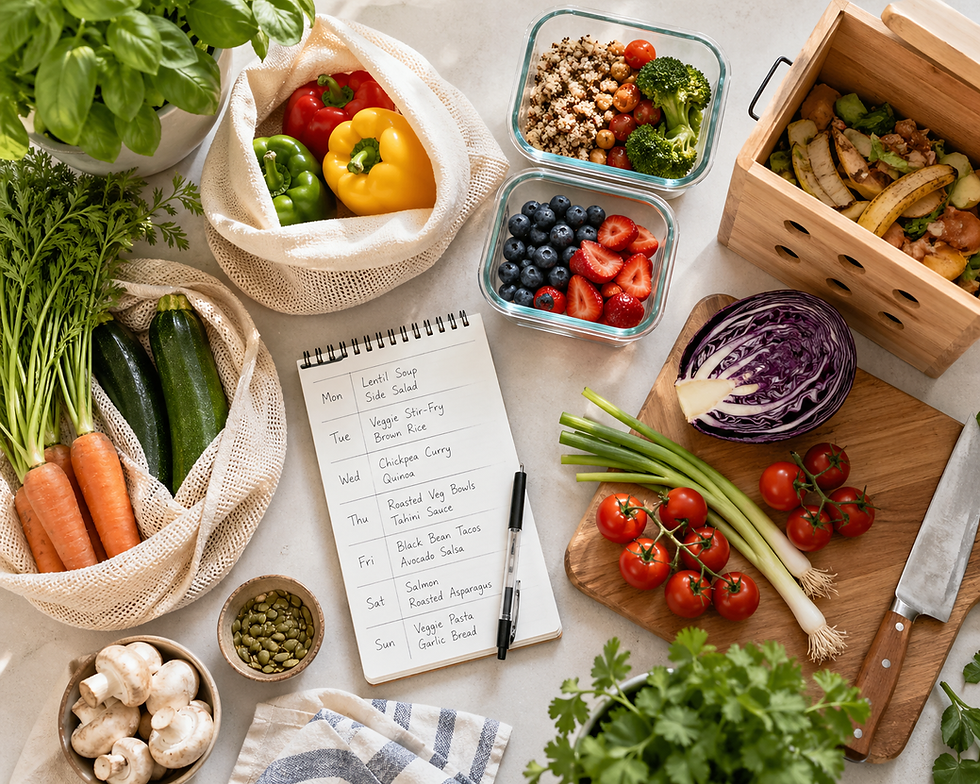
Meal planning is the single most impactful habit you can build to reduce food waste at home. Making a shopping list with weekly meals in mind saves time and money — if you only buy what you expect to use, you are far more likely to eat it all. Before heading to the store, check your refrigerator, freezer, and pantry, and build your meals around what you already have rather than starting from scratch.
2. Write a Shopping List and Stick to It
A meal plan only works if the shopping list reflects it. Check your refrigerator, freezer, and pantry first to avoid buying food you already have, and make a list each week of what needs to be used up so you can plan upcoming meals around it. Including quantities on your list — for example, "salad greens: enough for two lunches" — prevents overbuying on individual items.
3. Shop Smart, Not in Bulk
Be wary of impulse buys and specials on foods you do not normally eat, and avoid shopping while hungry, as hunger influences how much and what you purchase. When possible, buy exact amounts — single fruits and vegetables rather than pre-bagged quantities, and grains, nuts, and seeds from bulk bins where you control the portion.
4. Understand "Best Before" vs. "Use By"
This one distinction alone can save a meaningful amount of food every week. "Use by" dates relate to safety and should be respected. "Best before" dates signal peak quality only — food past this date is often still perfectly safe. Smell it, examine it, and use your judgment before discarding anything based on a date label alone.
5. Store Food Correctly
Proper storage dramatically extends the life of your groceries. Climacteric fruits — including apples, avocados, bananas, mangoes, peaches, pears, and tomatoes — continue to ripen after harvest and should be stored at room temperature until ripe, then moved to the refrigerator. Non-climacteric fruits such as berries, citrus, and grapes should be refrigerated promptly. Herbs last significantly longer when stored like flowers — stems trimmed and placed upright in a glass of water in the fridge. Use airtight containers for leftovers and cut produce, and keep raw meats on the lowest shelf to prevent cross-contamination.
6. Use the FIFO Method
"First In, First Out" is a principle borrowed from professional kitchens that works just as well at home. When you unpack new groceries, move older items to the front of the shelf or fridge and place new purchases behind them. This ensures older food gets used before it spoils and nothing quietly expires at the back of a shelf.
7. Embrace Frozen Food
Frozen produce is not a compromise — it is a smart waste-reduction strategy. Frozen food results in 47% less household food waste than fresh food. Frozen fruits and vegetables carry the same nutritional value as fresh and allow you to use exactly what you need without time pressure. Bread, meat, and dairy can all be frozen before they reach the end of their usable window, extending their life by weeks.
8. Get Creative With Leftovers
The key shift is seeing leftovers not as second-best meals, but as a head start on the next one. Curries, chilis, stir-fries, and grain bowls are all easy, adaptable dishes that can incorporate whatever ingredients you have on hand. A frittata or scrambled eggs can absorb nearly any leftover vegetable or protein. Soup is one of the most forgiving formats for odds and ends. Wraps, fried rice, and pasta dishes are equally flexible.
9. Use Every Part of the Food
Much of what gets trimmed away is perfectly edible. Carrot tops can be blended into pesto. Broccoli stems can be roasted or added to stir-fries. Citrus peels can be zested into baked goods or steeped into syrups. Vegetable scraps — onion skins, celery leaves, herb stems, corn cobs — make excellent homemade stock. Before anything goes into the bin, ask whether it has a second use.
10. Audit Your Fridge Regularly
A dry-erase board on your refrigerator can help you track what needs to be eaten first, preventing older leftovers from getting pushed to the back and forgotten. An "Eat This First" shelf — where you place items nearing the end of their prime — is another simple system that costs nothing and saves a surprising amount of food. A weekly scan before you shop ensures you use what you have before buying more.
11. Compost and Donate What You Cannot Use
Even the most waste-conscious kitchen generates some scraps. Composting keeps organic matter out of landfills and the methane cycle. Home composting — through an outdoor bin, a countertop composter, or a community program — converts food scraps into nutrient-rich soil. For unexpired food you genuinely cannot use, local food banks, community fridges, and neighborhood sharing programs are ready to receive it. By redirecting excess food to communities that need it, households reduce their own waste while directly addressing food insecurity in their area.
Frequently Asked Questions About Food Waste at Home
What is the main cause of food waste in homes?
The most common causes are buying more groceries than a household can use, poor food storage practices, and misreading date labels. Most people discard food they interpret as expired based on a "best before" label — when it is still perfectly safe to eat. Shopping without a plan and buying bulk deals that exceed what a household can realistically consume are equally significant drivers of waste.
How much money does the average household lose to food waste per year?
The average American household wastes approximately $1,500 worth of food per year — roughly a pound of food per person, per day. For a family of four, that figure rises to almost $3,000 annually on food that is bought but never eaten. Cutting food waste is one of the most immediate ways a household can lower monthly expenses without any meaningful sacrifice.
What are the environmental effects of food waste?
When food decomposes in landfills, it releases methane — a greenhouse gas 28 times more potent than carbon dioxide. Food loss and waste account for 8–10% of all global greenhouse gas emissions — a share comparable to the entire tourism industry. Beyond emissions, food waste squanders the water, energy, land, and labor used to produce food that nourishes no one.
What foods are wasted most often at home?
Fresh fruits and vegetables — particularly leafy greens, berries, and herbs — top the list, followed by dairy products, bread and baked goods, uneaten leftovers, and meat or seafood that spoiled before use. These items are wasted most because they are highly perishable and punish poor planning quickly.
What is the easiest first step to reduce food waste at home?
Start with a weekly meal plan. Making a list with weekly meals in mind means buying only what you expect to use — and you are far more likely to eat it all. Even a rough outline of dinners, combined with a quick fridge check before shopping, can dramatically cut spoilage within the first week.
Is frozen food better than fresh for reducing food waste?
In many cases, yes. Frozen food results in 47% less household food waste than fresh food. Frozen fruits, vegetables, and proteins carry the same nutritional value as fresh counterparts and let you use exactly what you need, when you need it, without time pressure.
Does composting count as reducing food waste?
Composting is valuable, but it sits at the end of the waste-reduction hierarchy. The priority is always to prevent food from being wasted in the first place through better shopping, storage, and cooking. Composting handles the unavoidable remainder — vegetable trimmings, eggshells, coffee grounds — and keeps it out of landfills. It is far better than binning scraps, but it is a last resort rather than a first solution.
The Bottom Line
Reducing food waste at home does not require a dramatic lifestyle overhaul. It asks for small, consistent habits — a weekly meal plan, a fridge audit before shopping, a willingness to turn last night's roasted vegetables into tomorrow's soup. Preventing food from going to waste is one of the easiest and most powerful actions a household can take to save money and reduce its environmental footprint.
The environmental stakes are real, the financial savings are immediate, and the social argument is hard to ignore. Every item that travels from your shopping bag to your plate — rather than to the bin — is a small but meaningful act of sustainability. Start with one or two changes this week. The rest will follow naturally.
Related articles:
🛒 Ready-to-Use Lesson Plan — Available Now
Stop spending your weekends writing lessons from scratch.
If you teach Grades 3–5 and want a fully done-for-you unit on food waste, this 5-Day Lesson Plan on Food Waste at Home has everything ready to print and use — visual aid slide prompts, word-for-word teacher scripts, student worksheets, and scoring rubrics for all five days.
No prep. No blank templates. Just open, print, and teach.
References
Harvard T.H. Chan School of Public Health – The Nutrition Source. Tackling Food Waste at Home. https://nutritionsource.hsph.harvard.edu/sustainability/food-waste/food-waste-home/
United States Environmental Protection Agency. Preventing Wasted Food at Home. https://www.epa.gov/recycle/preventing-wasted-food-home
Amazing Food & Drink. Reducing Food Waste at Home: 17 Tips for a Greener Kitchen. https://amazingfoodanddrink.com/reducing-food-waste-at-home/
High Speed Training. How to Reduce Food Waste at Home: 10 Top Tips. https://www.highspeedtraining.co.uk/hub/reduce-food-waste/
Forks Over Knives. 20 Pro Tips to Reduce Food Waste at Home. https://www.forksoverknives.com/how-tos/how-to-reduce-food-waste-using-what-you-have/
Sustainably Forward. How to Reduce Food Waste at Home: 7 Easy Tips. https://sustainablyforward.com/how-to-reduce-food-waste-at-home/
Tiny Spoon Chef. A Comprehensive Guide to Reducing Food Waste at Home. https://www.tinyspoonchef.com/blog/a-comprehensive-guide-to-reducing-food-waste-at-home
Earth.Org. #StopFoodWasteDay 2026: 11 Effective Solutions for Food Waste. https://earth.org/solutions-for-food-waste/


Comments