Food Waste in Schools: Causes, Effects, and Solutions
- Dean Rusk Delicana
- May 1
- 8 min read

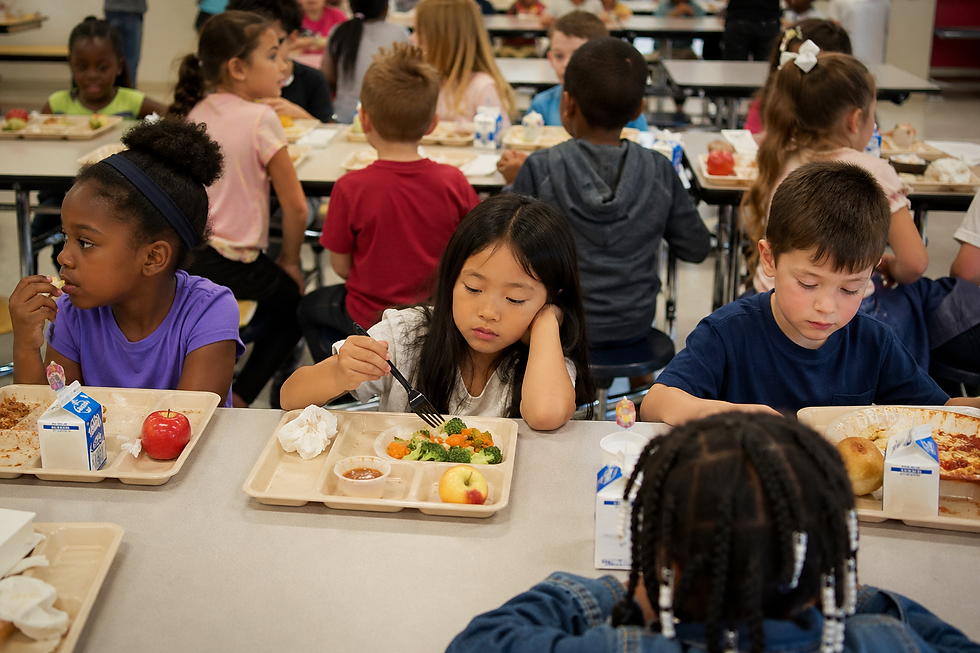
Food waste in schools is one of the most overlooked problems in education today — and it happens every single day. Across cafeterias worldwide, nutritious meals go uneaten: apples tossed after a single bite, milk cartons left unopened, vegetables untouched from start to finish. For schools already navigating tight budgets, staffing challenges, and the pressure to feed hundreds of children at once, the waste isn't just frustrating — it's costly, inequitable, and damaging to the environment.
But here's the thing: most of it is preventable.
What Is Food Waste in Schools?
Food waste in schools refers to edible food that is discarded or left uneaten in school cafeterias and kitchens — including untouched fruit, unopened milk, and unfinished meals. Studies estimate that between 30 and 40 percent of all food produced for school meals is wasted, representing not only lost resources but missed opportunities to nourish students and support sustainability goals.
This article explores why school food waste happens, what it costs us, and — most importantly — what schools, parents, and communities can do to turn the tide.
How Big Is the School Food Waste Problem?
The scale of food waste in schools is difficult to ignore. About 90 billion pounds of edible food goes uneaten in the United States each year — roughly $372 per person — with about 8% of all wasted food coming from institutional and foodservice settings, including schools.
In the United Kingdom, the Waste and Resources Action Programme (WRAP) found that in one academic year, primary schools generate 68,000 tonnes of food waste, while secondary schools generate 28,000 tonnes — a combined total of 96,000 tonnes.
Critically, most of this waste doesn't have to happen. A WRAP study found that 78% of primary school food waste and 77% of secondary school food waste was avoidable, with fruits and vegetables making up the largest proportion of discarded food.
What Foods Are Wasted Most in Schools?
Understanding which foods get wasted most often is key to finding targeted solutions.
Milk consistently ranks among the most wasted items in American schools, with estimates of up to 30–40 percent discarded even when students are encouraged to take it.
Fruits and vegetables are the second most wasted food group — and also the most important source of dietary fiber on school menus. Whole fruits like apples and oranges, and large portions of salads, frequently end up in the trash.
Entrées and grains also see high rates of waste, especially when lunch periods run short. The national average is just 20 minutes of seated time at lunch — and in practice, actual seated time can be as short as 10 minutes once queuing and clean-up are factored in.
Causes of Food Waste in Schools
Reducing food waste in schools starts with understanding why it happens. The causes are varied, and more often structural than a matter of student pickiness.
Short lunch periods. Time is one of the biggest drivers of waste. A survey by NPR and the Harvard School of Public Health found that 20% of parents of K–5 students reported their child had 15 minutes or less to eat. When students are rushed, food gets left behind.
Student preferences and unfamiliarity. In a series of food waste audits, SEEDS found that nearly half (48%) of students who left food uneaten said they were "full" or "not hungry," with fruits and vegetables most commonly left behind. A further 19% cited disliking the food, and 17% said they ran out of time to finish eating. Taste and texture concerns — such as the metallic flavor of canned produce — were also frequently cited.
Mandatory meal components. Many school meal programs require students to take certain items regardless of whether they plan to eat them. This well-intentioned policy can drive up waste when required items are taken only to be discarded.
Poor menu planning and over-ordering. Schools operating on tight budgets with limited kitchen staff often struggle with over-ordering, inefficient storage, and inflexible menus — all of which generate waste before food even reaches a student's tray.
Lack of food education. When students don't understand where food comes from, what it costs, or what happens when it's wasted, they're less likely to make mindful choices at mealtimes.
Effects of Food Waste in Schools
The impact of food waste in schools extends well beyond the cafeteria.
Environmental Impact
When food is sent to a landfill instead of being composted, it produces methane — a greenhouse gas that is 84 times more potent than carbon dioxide and carries 28 times the global warming potential. Every tray of wasted food also represents wasted water, land, energy, and labor used to grow and transport it.
Financial Impact
Food thrown away is money thrown away. The USDA has noted that millions of dollars' worth of food are discarded annually from school meal programs — funds drawn from already-strained school budgets and public spending. Reducing waste is one of the most direct ways schools can redirect resources toward better ingredients and improved programs.
Impact on Student Nutrition and Equity
This is perhaps the most urgent consequence of all. For some children, school lunch is the only guaranteed meal of the day. In the UK, 18.7% of households with children reported that children were directly experiencing food insecurity in 2024.
A 2024 report found that 38% of teachers reported their pupils were regularly too hungry to learn. When nutritious food is wasted in this context, it isn't just an environmental problem — it's a matter of justice. Children who needed that meal didn't get it.
Solutions: How to Reduce Food Waste in Schools
The good news is that effective, proven strategies exist — and many schools are already putting them to work. Here is what the evidence says about reducing food waste in K-12 schools.
1. Implement the Offer vs. Serve (OVS) Model
Under the USDA's Offer vs. Serve approach, students are offered all five meal components — grain, protein, fruit, vegetable, and milk — but only need to take a minimum of three, including at least one fruit or vegetable, for it to count as a reimbursable meal. When implemented correctly, this approach can reduce waste without compromising nutrition or participation.
Research shows that 81% of elementary and middle schools implementing OVS at lunchtime have seen a notable reduction in food waste.
2. Extend Lunch Periods
Extending lunch periods to at least 30 minutes allows students more time to finish their meals, reducing overall food waste. It's one of the simplest, highest-impact changes a school can make.
3. Set Up Share Tables
Share tables allow students to leave unopened or untouched food items for classmates to take freely — at no extra cost. The majority of students interviewed across multiple school sites said they were "full" or "not hungry" by the end of mealtime, underscoring the importance of making a share table available. Share tables reduce waste and address food insecurity simultaneously.
4. Improve Ordering, Prepping, and Storage
Schools can reduce food waste through improved ordering, prepping, and storage techniques — and can recover wholesome uneaten food to donate to people in need, or recycle discarded food for uses including animal feed, compost, and energy generation.
5. Start Composting Programs
Composting diverts organic material from landfills and can feed school gardens, creating a learning loop students can engage with directly. Schools that partner with local composting services — or manage on-site compost bins — turn an environmental liability into an educational asset.
6. Listen to Students
The majority of students were enthusiastic about sharing ways that would enable them to eat more fruits and vegetables and contribute positive change to their school's food system. Involving students in taste tests, food audits, and menu feedback sessions turns them from passive recipients into active problem-solvers.
7. Promote School Meals Creatively
Schools can generate enthusiasm for meals by showcasing new menu items on serving lines, organizing taste tests and recipe contests, and establishing student advisory groups to provide input on meal preferences and portion sizes. Familiarity builds acceptance — students eat what they helped choose.
8. Partner with Local Food Banks
Surplus food that is still safe to eat should never go to waste when families in the community are food insecure. Partnerships with local food banks and community organizations turn cafeteria surplus into a resource rather than a problem.
9. Conduct Regular Food Waste Audits
You can't fix what you don't measure. Regular food waste audits — tracking what is wasted, how much, and why — give schools the data they need to make targeted improvements. They also make powerful teaching tools that bring sustainability lessons to life.
10. Integrate Food Literacy Into the Curriculum
Lasting change comes from awareness. Teaching students about where food comes from, how it is produced, what it costs, and what happens when it is wasted builds habits that extend well beyond the cafeteria — and into the rest of their lives.
The Bottom Line
Food waste in schools sits at the intersection of environmental sustainability, public health, and social equity. It is not caused by any single person, policy, or generation — it is the product of systems that were never quite designed with waste prevention in mind.
But systems can change. And schools — places of learning, growth, and community — are exactly the right places to start. Whether you are a school administrator, a parent, a teacher, or a student, there is a role for you in this effort.
The cafeteria tray does not have to end up in the bin. With the right structures, the right policies, and the right conversations, it can become what it was always meant to be: a full meal, well eaten.
🍎 Ready to Take This Into Your Classroom?
If this article opened your eyes to the scale of food waste in schools, imagine what it could do for your students.
Don't Trash It! is a complete, ready-to-teach 5-day lesson bundle that turns everything you just read into an engaging, hands-on learning experience for Grades 3–5. Your students will investigate why food gets wasted, explore its real costs, and walk away with the knowledge — and the confidence — to become change-makers in their own school cafeteria.
No prep stress. No hunting for resources. Everything is written, formatted, and ready to go.
What's inside: ✅ 5 complete lesson plans (60 minutes each) ✅ 5 student worksheets with guided prompts and creative tasks ✅ 5 detailed rubrics for easy, consistent assessment ✅ 5 visual aid titles and image prompts for every lesson ✅ 5 teacher scripts to guide meaningful classroom discussion ✅ Grounded in research from the USDA, WWF, SEEDS, WRAP, and the School Nutrition Association
Instant download. Compatible with Microsoft Word and Google Docs. Ready to teach tomorrow.
Related articles:
References
Gordon, R. (2025). 10 Ways to Reduce Food Waste at School. High Speed Training. https://www.highspeedtraining.co.uk/hub/food-waste-in-schools/
WWF & SEEDS. (2025). Fighting Food Waste in Schools With WWF. World Wildlife Fund. https://www.worldwildlife.org/our-work/food/food-waste/fighting-food-waste-in-schools/
Araújo, T. (2025). Why So Much School Food Ends Up in the Trash, and How We Can Fix It! Balanced. https://www.balanced.org/post/why-so-much-school-food-ends-up-in-the-trash-and-how-we-can-fix-it
PanFlavor. (n.d.). Reducing Food Waste in Schools: Strategies and Impact. https://panflavor.com/how-do-schools-deal-with-food-waste/
School Nutrition Association. (2024). Strategies to Address Food Waste in K-12 Schools: A Narrative Review. https://schoolnutrition.org/journal/spring-2024-strategies-to-address-food-waste-in-k-12-schools-a-narrative-review/
Folliard, J., Hardy, M., & Benson, F. (2024). Food Waste in Schools and Strategies to Reduce It. SDSU Extension. https://extension.sdstate.edu/food-waste-schools-and-strategies-reduce-it
CleanRiver. (n.d.). Minimizing Food Waste in K-12 Schools: Steps Toward a Sustainable Future. https://cleanriver.com/resource/minimizing-food-waste-in-k-12-schools-steps-toward-a-sustainable-future/
U.S. Department of Agriculture. (n.d.). Schools. USDA Food Loss and Waste. https://www.usda.gov/foodlossandwaste/schools
SEEDS. (2025). Tackling Food Waste in Schools — What Students Are Telling Us and How We Can Act. https://ecoseeds.org/tackling-food-waste-in-schools-what-students-are-telling-us-and-how-we-can-act/


Comments