How Schools Are Fighting the Climate Crisis: Understanding and Reducing the Carbon Footprint in Education
- Dean Rusk Delicana
- May 12
- 12 min read

Schools are among the largest contributors to greenhouse gas emissions in the public sector — but they're also one of our most powerful tools for reversing the trend. Here's everything you need to know.
Why Schools Must Face Their Own Carbon Footprint
When we talk about fighting climate change, we often think of factories, power plants, and automobiles. Schools rarely make the headline. But the numbers tell a different story.
K-12 schools spend approximately $8 billion annually on energy and emit an estimated 72 million metric tons of carbon dioxide — the equivalent of 18 coal-fired power plants per year, according to the U.S. Department of Energy. That is an extraordinary environmental burden carried by institutions whose core mission is to prepare young people for the future.
There is both an irony and an opportunity here. Schools shape the values, habits, and worldviews of the next generation. Ultimately, it will be down to our young people to solve the climate emergency — so what better way to inspire the next generation of change-makers than by giving them opportunities to become active citizens empowered to solve some of the most pressing issues we face? But that inspiration rings hollow if the school buildings themselves are part of the problem.
The good news: schools that take their carbon footprint seriously are already proving that dramatic change is possible — and that the lessons they learn are ones the rest of us can apply too.
What Is a School's Carbon Footprint? Understanding the Sources
Before a school can reduce its footprint, it has to understand where its emissions come from. A carbon footprint is the total amount of greenhouse gases — specifically carbon dioxide and methane — emitted directly or indirectly by an individual, organization, or activity, typically measured in units of carbon dioxide equivalents (CO2e). In a school setting, this includes emissions from energy consumption, transportation, waste production, and other activities within the institution.
Research shows that energy consumption accounts for roughly 40% of a school's carbon footprint, transportation contributes around 30%, waste management around 20%, and water use the remaining 10%.
Let's look at each source more closely.
Energy Consumption: The Biggest Culprit
Heating, cooling, lighting, and powering technology across large buildings day after day makes energy consumption the single largest driver of school emissions. Older school buildings — often built decades before energy efficiency was a design priority — can be especially energy-hungry, with poor insulation, outdated HVAC systems, and inefficient lighting throughout.
Transportation: Getting to and from School
The daily commute of thousands of students and staff, mostly by car, adds up to a massive transportation footprint. A single-occupancy car trip to school produces approximately 808 grams of CO2 per trip, compared to zero for walking or cycling. Multiply that by hundreds of students across hundreds of school days, and the scale becomes clear.
Waste and Cafeterias
School cafeterias generate significant food waste, and organic materials decomposing in landfills release methane — a greenhouse gas far more potent than CO2. Paper waste from classrooms, single-use plastics at lunch, and general campus waste all compound the problem.
Water Use
Water heating and treatment require energy, and wasteful water habits in schools — leaking taps, inefficient fixtures, unnecessary irrigation — quietly add to the institution's overall emissions.
The Effects: Why This Matters Beyond School Grounds
The environmental consequences of a high school's carbon footprint do not stay neatly within campus boundaries.
Schools that implement sustainable design strategies tend to operate much more efficiently than conventional schools and, as a result, generate far fewer greenhouse gas emissions. Many schools also take steps to reduce their water usage, helping to conserve water and effectively mitigate excess stormwater runoff.
But the stakes go further than local water tables. Schools contribute to the broader climate crisis — rising global temperatures, more intense weather events, and ecosystem disruption that will affect the very students sitting in those classrooms today. There is also an indoor impact: energy-inefficient buildings often rely on fossil fuel combustion systems that degrade air quality, exposing students and staff to pollutants that harm respiratory health and cognitive performance.
Reducing the carbon footprint at school enhances air quality and reduces pollution-related health risks for students and staff, and positions schools as role models in the community for sustainability initiatives.
The behavioral dimension matters, too. When students learn in a building that wastes energy, produces excess waste, and depends on car travel, they absorb those norms. They come to see them as natural — as simply the way things are done. Schools, whether they intend to or not, are always teaching.
Real Schools, Real Results: Institutions Leading the Way
The most compelling evidence that schools can radically reduce their carbon footprint comes from institutions already doing it. These are not hypothetical future schools — they exist right now, and their approaches offer a practical blueprint for others.
Annie E. Fales Elementary School, Massachusetts, USA
Annie E. Fales Elementary School in Massachusetts boasts net-positive carbon status, producing more power via renewable energy than it requires in a year's time. This means the school does not merely offset its emissions — it is a net energy producer, feeding clean electricity back into the grid. This is the gold standard of school sustainability, proving that even a K-12 facility can exceed net-zero.
The Blake School, Minnesota, USA
The Blake School uses structural glulam beams that extend beyond the building's facade to filter interior light — a design strategy that reduces dependence on artificial lighting and lowers energy demand while creating a healthier learning environment. The school exemplifies how architectural choices made at the design stage translate into decades of reduced emissions.
The Thaden School, Arkansas, USA
The Thaden School has taken deliberate steps to reduce its environmental impact through a combination of green building materials, landscape design that supports local ecology, and energy-efficient systems. The school's campus, designed by Marlon Blackwell Architects, integrates sustainability from the ground up rather than bolting it on as an afterthought.
Ladies' College, Guernsey
This institution demonstrates that student-led action is just as powerful as architectural innovation. Students from the Ladies' College in Guernsey joined with other schools to work on a carbon reduction plan, and they subsequently met with ministers from local government. They lowered their school's impact on the environment by decreasing car travel, using renewable sources of energy, and reducing food waste, as well as contributing toward the island's environmental strategy. Here, the school did not just reduce its carbon footprint — it shaped public policy.
What Works: Proven Solutions for Reducing Carbon Footprint in Schools
The schools above are not outliers. Their approaches can be replicated. Here is what research and experience consistently show to be most effective.
1. Switch to Energy-Efficient Systems and Renewable Energy
Schools can harness renewable energy sources by installing solar panels. Not only do these initiatives lower operational costs, but they also serve as real-life teaching tools for students, demonstrating the practical applications of renewable energy. greenpacks
Inside buildings, the shift to LED lighting makes an immediate difference. LED bulbs consume around 10 watts of energy with a lifespan of 25,000 hours, compared to 60 watts and 1,000 hours for a traditional incandescent bulb — resulting in dramatically lower annual costs and energy use.
2. Transform Transportation Habits
Schools can promote walking, biking, carpooling, or using public transportation. To support biking and walking, schools can improve safety by providing designated bike racks and safe paths. Hosting events like "Bike to School Day" can also motivate families to embrace environmentally friendly habits.
Encouraging ride-sharing schemes and alternative modes of transport is one area where all school staff and students can play an active role in reducing their school's carbon emissions.
3. Build Robust Waste Reduction Programs
By instituting comprehensive recycling systems, schools can decrease the amount of waste sent to landfills, which is crucial since decomposing waste releases harmful greenhouse gases.
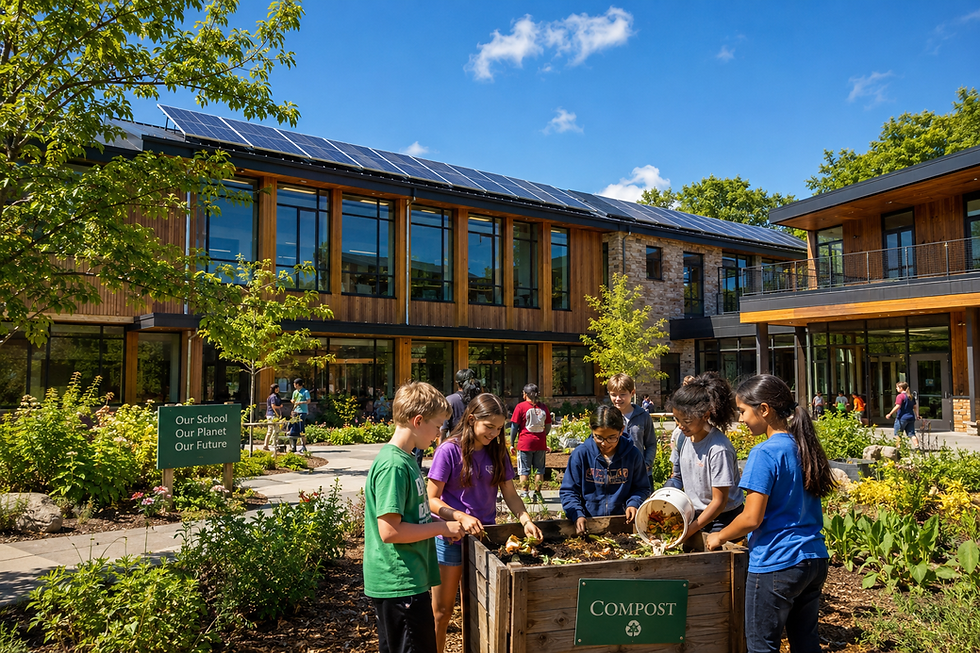
Schools can also establish composting programs that convert organic waste — such as food scraps and yard debris — into nutrient-rich compost. This reduces landfill waste and supports gardening and landscaping efforts on campus.
4. Upgrade Buildings with Sustainable Design Principles
Sustainable or green schools reduce environmental impacts and costs, improve occupants' health and performance, and provide effective sustainability education. In practice, sustainably designed schools achieve these goals by drastically limiting energy and water use, reducing waste production, protecting nearby natural habitats, minimizing exposure to VOCs and other toxins, and maximizing natural light.
For existing buildings, retrofit measures — improved insulation, smart thermostats, double-glazed windows, and energy-efficient HVAC systems — can dramatically cut energy waste without requiring a complete rebuild.
5. Conserve Water
Installing water-saving fixtures such as low-flow faucets and dual-flush toilets can reduce water usage by nearly a third compared to traditional fixtures, resulting in lower utility bills and a smaller environmental footprint.
6. Empower Students as Climate Agents
Creating eco-committees within schools can amplify sustainability efforts while promoting leadership among students. These committees can be responsible for implementing green initiatives, organizing events, and collaborating with faculty to enhance environmental awareness.
Teaching children about carbon footprint is more than just an educational exercise — it's a chance to shape their understanding of sustainability and responsibility.
7. Integrate Technology for Monitoring
Digital platforms can track energy usage, water consumption, and carbon emissions within the school, and apps can engage students in monitoring their school's environmental progress. Making data visible — to students, teachers, and administrators — creates accountability and turns abstract targets into concrete progress.
Lessons for Everyone: What Schools Are Teaching the World
The schools leading on sustainability are not just reducing their own emissions. They are generating lessons that apply to every organization, household, and community.
The first lesson is that measurement enables change. Schools that audit their energy use, track their waste, and map their transportation patterns gain the clarity needed to act. What gets measured gets managed.
The second is that design matters enormously. Sustainable school design can reduce carbon emissions, lower operating costs, and provide healthier indoor environments, higher attendance rates, and improved productivity. The decisions made when a building is designed — or redesigned — echo for decades.
The third is that culture is as important as technology. Solar panels save energy. But students who grow up understanding why solar panels matter will make better decisions as adults, engineers, policymakers, and parents. The human dimension of sustainability is irreplaceable.
And the fourth: collective action at scale starts small. The Ladies' College students who met with Guernsey's ministers did not start by lobbying for national policy. They started by measuring their school's footprint and working on a reduction plan. The ripple effects were substantial.
A Call to Action: Your Role in the School Carbon Footprint Revolution
This is not a problem that belongs only to architects, school administrators, or government officials. Every person connected to a school — student, parent, teacher, governor, neighbor, or alumnus — has a role to play.
If you are a student: Start asking questions. What is your school's energy source? How much waste does your cafeteria produce? Propose an eco-committee. Start a composting initiative. Measure your school's carbon footprint as a class project and present the findings to leadership. Young people have already changed public policy — and your school is the perfect place to begin.
If you are a teacher or educator: Bring sustainability into your curriculum, no matter your subject. History teachers can explore the industrial origins of the climate crisis. Science teachers can run energy audits. Math teachers can calculate emissions. Art teachers can design sustainability campaigns. Climate education is not a separate subject — it threads through everything.
If you are a school administrator or governor: Commission an energy audit. Set a net-zero target with a credible timeline. Investigate retrofit grants and renewable energy financing. Engage students and staff in your sustainability planning — not as a PR exercise, but as genuine partners.
If you are a parent: Talk to your school board. Ask about sustainability policies. Choose walking, cycling, or carpooling where possible. Support school initiatives that reduce waste and energy use. Your advocacy carries enormous weight.
If you are a policymaker or funder: The evidence is clear that sustainable school design pays for itself over time in reduced energy costs, improved health outcomes, and better educational performance. Prioritize green school retrofits. Fund student-led climate research. Make sustainability a standard, not an optional extra.
The school carbon footprint is not a niche environmental issue. It sits at the intersection of public health, educational quality, fiscal responsibility, and our collective future. Schools that reduce their emissions are not just doing the right thing for the planet — they are building better places to learn, teaching the values the next generation will need, and proving to their communities that change is possible.
The classroom is ready. The lesson has already begun. The question is whether we will act on what it teaches.
Take It Further: A Ready-Made Resource for Middle School Climate Education
If you are a teacher, homeschooling parent, or school administrator looking for a practical way to bring carbon footprint education into the classroom, we have something made just for you.
Your Middle Schoolers Are Ready for the Hard Questions About Climate is a set of five debate-ready carbon footprint lessons designed specifically for Grades 6–8. These lessons do not just inform students about climate change — they challenge them to think critically, argue confidently, and engage with the real-world complexity of the issues shaping their future.
Each lesson is structured around debate, so students are not passive recipients of information. They are active participants — researching, reasoning, and defending positions on the very questions that matter most right now. It is the kind of learning that sticks.
Whether you are building a sustainability unit from scratch or looking to add depth to what you already teach, these lessons slot in seamlessly and are ready to use from the moment you download them.
Your students are already asking the hard questions. These lessons help them find the answers — and the confidence to act on them.
Frequently Asked Questions About Carbon Footprint in Schools
What is a carbon footprint in the context of schools?
A school's carbon footprint is the total amount of greenhouse gases — primarily carbon dioxide and methane — produced by all of its activities. This includes energy used to heat, cool, and light buildings; transportation of students and staff; food waste from cafeterias; and water consumption. It is measured in units of carbon dioxide equivalents (CO2e).
Why do schools have such a large carbon footprint?
Schools are large, energy-intensive institutions that operate for hundreds of days a year. Most school buildings were constructed before modern energy efficiency standards existed, making them prone to heat loss, overcooling, and high electricity consumption. Add to that the daily transportation of thousands of students and staff — mostly by car — and the daily waste generated by cafeterias and classrooms, and the cumulative impact becomes significant.
How much CO2 do schools emit annually?
In the United States alone, K-12 schools emit an estimated 72 million metric tons of carbon dioxide every year — the equivalent of running 18 coal-fired power plants continuously. Globally, the figure is far higher.
What is the biggest source of carbon emissions in schools?
Energy consumption is the largest single contributor, accounting for approximately 40% of a school's total carbon footprint. This is followed by transportation at around 30%, waste management at 20%, and water use at 10%.
Can a school actually reach net-zero or carbon-positive status?
Yes — and some already have. Annie E. Fales Elementary School in Massachusetts, for example, produces more energy through renewable sources than it consumes in a full year, giving it net-positive carbon status. This is achievable through a combination of solar energy, energy-efficient design, and reduced consumption habits across the school community.
What is the fastest way for a school to reduce its carbon footprint?
Switching to LED lighting and conducting an energy audit are among the quickest and most cost-effective first steps. LED bulbs use significantly less energy than traditional incandescent bulbs and last far longer, delivering immediate reductions in both emissions and utility costs. Encouraging walking, cycling, and carpooling can also produce rapid results without requiring major capital investment.
How can students contribute to reducing their school's carbon footprint?
Students can propose and lead eco-committees, run composting and recycling initiatives, conduct carbon footprint audits as class projects, advocate for greener school policies, and encourage sustainable transportation habits among peers and families. Student-led efforts at schools like Ladies' College in Guernsey have even influenced local government environmental policy.
Does reducing a school's carbon footprint save money?
Yes. Energy-efficient upgrades — solar panels, LED lighting, smart heating and cooling systems, and water-saving fixtures — all reduce utility costs over time. Many schools recoup their initial investment within a few years and enjoy long-term savings that can be redirected toward educational resources.
How does a school's carbon footprint affect students' health?
Schools with poor energy efficiency often rely on outdated heating systems that degrade indoor air quality, exposing students and staff to pollutants that can harm respiratory health and reduce concentration. Sustainable schools, by contrast, tend to have better ventilation, more natural light, and healthier indoor environments — all of which are linked to improved attendance and academic performance.
Where can schools start if they want to reduce their carbon footprint?
The best starting point is a comprehensive energy audit to understand where emissions are coming from. From there, schools can set measurable targets, prioritize the highest-impact changes — such as renewable energy installation and transportation reform — and involve students, staff, and the wider community in the process. Forming a dedicated eco-committee gives the effort structure and momentum.
Related Articles:
Sources
Biro, Andrew. "Sustainable School Design: Examples, Trends, and Tips in 2025." gb&d Magazine, April 22, 2025. https://gbdmagazine.com/sustainable-school-design/
Chomsky, Raf. "Top 10 Most Sustainable Schools in the World." Sustainable Review, August 20, 2023. https://sustainablereview.com/top-10-most-sustainable-schools-in-the-world/
"20 Top Business Schools For Eco-Conscious Students." GMAC, 2024. https://www.gmac.com/resources/learners/business-programs/explore-programs/top-business-schools-for-eco-conscious-students
"Why Schools Need to Look at Their Own Carbon Footprint." Harvard Graduate School of Education — Usable Knowledge, November 2021. https://www.gse.harvard.edu/ideas/usable-knowledge/21/11/why-schools-need-look-their-own-carbon-footprint
Foster, Jo. "10 Ideas for Lowering Carbon Emissions in Schools." Institute for Research in Schools (IRIS), April 2023. https://researchinschools.org/lowering-carbon-emissions/
"Reduce the Carbon Footprint in Your Classroom — 22 Teacher Ideas." We Are Teachers. https://www.weareteachers.com/reduce-classroom-carbon-footprint/
"10 Simple Ways to Reduce Carbon Footprint at School." Median Energy, November 2, 2024. https://www.medianenergy.com/blog/10-ways-to-reduce-carbon-footprint-at-school
Greene, Mason. "Reduce Carbon Footprint in Schools with Our Step-by-Step Guide." The Eco Shift, April 5, 2026. https://theecoshift.com/reducing-carbon-footprint-in-schools-guide/
"How Can Schools Reduce Their Carbon Footprint?" Sustainability Directory. https://lifestyle.sustainability-directory.com/question/how-can-schools-reduce-their-carbon-footprint/
"How Can Schools Reduce Greenhouse Gas Emissions." Climate Control Journal. https://climatecontroljournal.com/how-can-schools-reduce-greenhouse-gas-emissions.html
Gallagher, Matt. "What Can Schools Do To Reduce Climate Change?" Green Packs, August 15, 2025. https://greenpacks.org/what-can-schools-do-to-reduce-climate-change/
"Schools' Environmental Footprint: Impact, Challenges, and Sustainable Solutions." ShunWaste. https://shunwaste.com/article/how-does-school-impact-the-environment


Comments