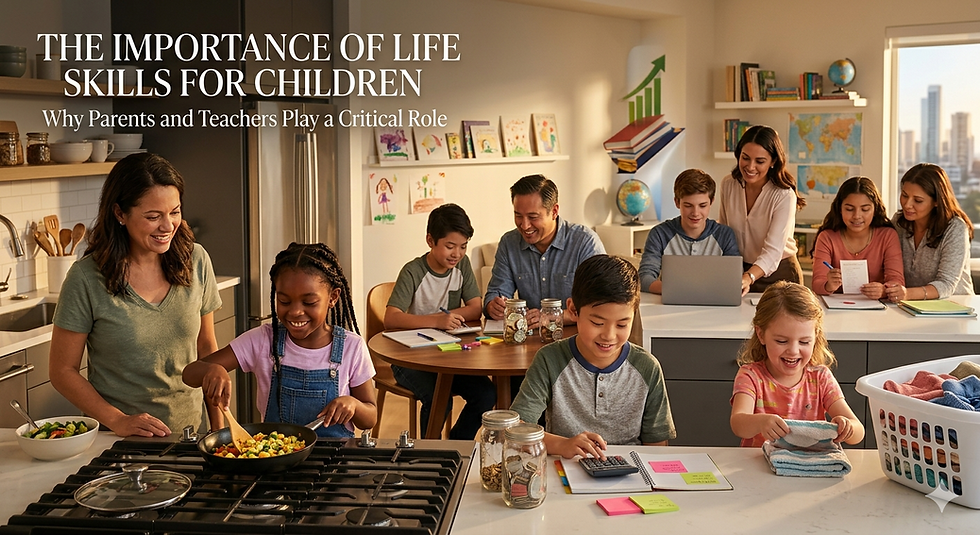
The Importance of Life Skills for Children: Why Parents and Teachers Play a Critical Role
- Dean Rusk Delicana
- Jun 3
- 7 min read

More Than Good Grades: Preparing Children for Real Life
Every parent wants their child to succeed. Every teacher hopes their students will thrive beyond the classroom. Yet many adults have watched academically successful young people struggle with everyday tasks such as managing money, resolving conflicts, handling stress, making decisions, or communicating effectively.
This is where life skills education becomes essential.
Life skills are the practical, social, emotional, and cognitive abilities that help individuals navigate everyday challenges successfully. Research from the World Health Organization (WHO) defines life skills as abilities that enable people to deal effectively with the demands and challenges of daily life. These skills include decision-making, problem-solving, critical thinking, communication, self-awareness, empathy, emotional regulation, and stress management.
In today's rapidly changing world, children need more than academic knowledge. They need the confidence and competence to manage real-world situations, build healthy relationships, make responsible decisions, and adapt to uncertainty.
This article explores why life skills matter, what skills children need at different ages, and how parents and teachers can work together to raise capable, resilient young people.
What Are Life Skills?
Life skills are learned abilities that help individuals function effectively in everyday situations. They bridge the gap between knowing something and applying that knowledge in real life.
According to the WHO framework, life skills fall into five major categories:
1. Decision-Making and Problem-Solving
Children learn how to:
Analyze situations
Consider consequences
Evaluate options
Make informed choices
2. Creative and Critical Thinking
These skills help children:
Generate solutions
Evaluate information
Question assumptions
Adapt to new challenges
3. Communication and Relationship Skills
Children develop the ability to:
Express themselves clearly
Listen actively
Resolve conflicts
Collaborate with others
4. Self-Awareness and Empathy
These skills support:
Emotional intelligence
Understanding personal strengths and weaknesses
Recognizing others' perspectives
Building healthy relationships
5. Coping with Emotions and Stress
Children learn how to:
Manage frustration
Handle disappointment
Build resilience
Maintain mental well-being
These skills are increasingly recognized worldwide as critical components of education and healthy development.
Why Life Skills Are More Important Than Ever
Today's children are growing up in a world that previous generations never experienced.
They face:
Constant digital connectivity
Social media pressures
Information overload
Increased mental health challenges
Rapid technological change
Greater social complexity
Recent educational research highlights that life skills help young people navigate personal, societal, and future challenges while promoting resilience and well-being.
Schools that intentionally integrate life skills create opportunities for students to connect learning with real-life situations and future responsibilities.
Without life skills, children may know how to solve algebra problems but struggle with everyday ones.
They may earn excellent grades yet find it difficult to:
Manage a budget
Handle criticism
Work collaboratively
Advocate for themselves
Cope with setbacks
Academic achievement alone is no longer sufficient preparation for adulthood.
The Benefits of Life Skills Education
Improved Academic Performance
Contrary to popular belief, teaching life skills does not take away from academic learning.
Research consistently shows that students with stronger social-emotional and self-management skills often perform better academically because they can:
Focus attention
Manage time
Persist through challenges
Work effectively with peers
Better Mental Health
Life skills provide children with tools to manage stress, anxiety, frustration, and disappointment.
When children learn emotional regulation and resilience early, they are better equipped to handle life's inevitable difficulties.
Greater Independence
Children who develop life skills become more self-sufficient.
They learn how to:
Complete daily tasks
Take responsibility
Solve problems independently
Make informed decisions
Stronger Relationships
Communication, empathy, and conflict-resolution skills help children build meaningful friendships and healthy family relationships.
Future Career Readiness
Employers consistently value soft skills such as:
Communication
Adaptability
Teamwork
Leadership
Problem-solving
Life skills education helps prepare children not only for jobs but for lifelong success.
Essential Life Skills Children Need by Age
Ages 2–4: Foundations of Independence
Children can begin learning:
Basic self-care
Tidying up toys
Following simple routines
Using polite language
Naming emotions
Ages 5–7: Growing Responsibility
Children are ready for:
Household chores
Simple cooking tasks
Safety awareness
Basic decision-making
Responsibility for belongings
Ages 8–10: Building Competence
Focus on:
Money awareness
Time management
Problem-solving
Conflict resolution
Organizational skills
Ages 11–13: Real-World Readiness
Children can learn:
Digital citizenship
Online safety
Goal setting
Basic first aid
Budgeting
Ages 14–17: Preparing for Adulthood
Teenagers benefit from learning:
Financial literacy
Job readiness
Independent cooking
Transportation skills
Professional communication
The earlier these skills are introduced, the more naturally they become part of a child's daily life.
The Role of Schools in Teaching Life Skills
Schools are uniquely positioned to provide structured opportunities for life skills development.
Research indicates that effective life skills education is often integrated into existing subjects rather than taught as a separate course. This allows students to practice skills within authentic learning experiences.
Teachers can support life skills development through:
Group projects
Classroom discussions
Problem-based learning
Role-playing activities
Reflective writing
Collaborative tasks
Life skills become meaningful when students apply them in real situations rather than simply learning about them.
The Role of Parents in Teaching Life Skills
Parents are children's first and most influential teachers.
Many life skills are best learned at home through daily experiences.
Parents can teach life skills by:
Involving Children in Household Tasks
Allow children to:
Help cook meals
Do laundry
Organize spaces
Care for pets
Encouraging Decision-Making
Instead of solving every problem, ask:
"What do you think your options are?"
"How could you handle this situation?"
Teaching Financial Responsibility
Provide opportunities to:
Budget spending money
Save toward goals
Compare prices
Modeling Emotional Regulation
Children learn emotional skills by watching adults manage their own emotions constructively.
A Practical Resource for Teaching Life Skills at Home
Many parents understand the importance of life skills but struggle with one question:
"Where do I start?"
That is exactly why They'll Leave Home One Day. Will They Be Ready? The Life Skills Activity Guide for Parents · Ages 2–17 was created.
Rather than offering vague advice, the guide provides a clear developmental roadmap with more than 50 age-appropriate activities covering children from ages 2 through 17.
Some highlights include:
Practical life skills activities tailored to five developmental stages
Emergency preparedness activities
Budgeting and financial literacy exercises
Meal planning and cooking experiences
Online safety instruction
Communication and conflict-resolution practice
First aid basics
Real-world independence skills
The guide also includes:
An Interactive Skills Progress Tracker
A Four-Week Getting Started Plan
Evidence-informed habit-building principles
Conversation scripts for common parenting challenges
For busy parents seeking practical, actionable ways to build life skills without feeling overwhelmed, this resource offers a structured, developmentally appropriate approach.
You can learn more here:
Common Mistakes Adults Make When Teaching Life Skills
Doing Everything for Children
Helping is important. Overhelping is not.
Children need opportunities to struggle, practice, and learn.
Waiting Until the Teenage Years
Life skills development begins in early childhood.
Small responsibilities in preschool often lead to greater competence later.
Prioritizing Academics Over Everything Else
Academic success and life skills are not competing goals.
They complement each other.
Expecting Perfection
Learning life skills involves mistakes.
The goal is progress, not perfection.
Frequently Asked Questions
What are the most important life skills children should learn?
According to the WHO framework, essential life skills include decision-making, problem-solving, critical thinking, communication, interpersonal relationships, self-awareness, empathy, coping with emotions, and stress management.
At what age should life skills training begin?
Life skills development begins in early childhood. Even toddlers can learn simple routines, responsibility, emotional vocabulary, and cooperation. Skills should be introduced gradually and become more complex as children mature.
Do life skills improve academic performance?
Yes. Research indicates that children with stronger self-management, communication, and emotional regulation skills often perform better academically because they can focus, persist, and collaborate effectively.
Can life skills be taught in schools?
Absolutely. Many educational systems integrate life skills into existing subjects rather than treating them as separate courses. Effective life skills education can occur through classroom discussions, projects, collaborative learning, and real-world applications.
How can parents teach life skills if they are busy?
The best approach is integrating learning into daily life. Cooking dinner, grocery shopping, doing laundry, budgeting, resolving family conflicts, and planning schedules all provide opportunities for life skills instruction.
Are life skills more important than academics?
Both are important. Academic knowledge helps children understand the world. Life skills help them function successfully within it. The most effective education develops both.
Final Thoughts
Children are not just preparing for the next test, grade level, or school year.
They are preparing for life.
When parents and teachers intentionally teach life skills, children gain more than competence. They develop confidence, resilience, independence, and the ability to navigate an increasingly complex world.
The ultimate goal is not simply raising successful students.
It is raising capable adults.
References
Brevik, L. M., Mathé, N. E. H., Gudmundsdottir, G. B., & Isaksen, A. R. (2025). Life skills education as a balancing act: Preparing students to handle life challenges in upper secondary English and social science classrooms. Teaching and Teacher Education, 154, 104992. https://doi.org/10.1016/j.tate.2025.104992
Heritage Girls School. (2024). Importance of life skills in education. https://www.heritagegirlsschool.com/blogs/importance-of-life-skills-in-education
International Journal for Multidisciplinary Research. (2024). Life skills education and foundational learning. https://www.ijfmr.com/papers/2024/1/13663.pdf
International Journal of Indian Psychology. (2024). Life skills education and child development. https://ijip.in/wp-content/uploads/2024/10/18.01.035.20241204.pdf
OECD. (2023). Skills for the future and life skills development. OECD Education Working Papers. https://one.oecd.org/document/EDU/WKP(2023)19/en/pdf
Pathways Education Project. (2024). The importance of life skills in academic education. https://www.pathwayseducationproject.com/post/the-importance-of-life-skills-in-academic-education
Teachers Institute. (2024). Integrating life skills education into school curricula. https://teachers.institute/childhood-growing-up/integrating-life-skills-education-school-curricula/
Varthana. (2024). Life skills and values in school education. https://varthana.com/school/blog/life-skills-and-values-in-school-education
World Health Organization. (2020). Life skills education school handbook: Prevention of noncommunicable diseases and promotion of health. Geneva, Switzerland: Author. https://iris.who.int/server/api/core/bitstreams/87fe5602-fd22-4d61-8605-26aa6a21f4c8/content
Yadav, S., & colleagues. (2025). Importance of life skills education in schools: A comprehensive literature review. Journal of Emerging Technologies and Innovative Research. https://www.jetir.org/view?paper=JETIR2508065
Yadav, S., & colleagues. (2025). Importance of life skills education in schools: A comprehensive literature review. Academia.edu. https://www.academia.edu/150029372/Importance_of_Life_Skills_Education_in_Schools_A_Comprehensive_Literature_Review



Comments