Stop Fighting Over Screens: Build a Family Media Plan That Actually Sticks
- Dean Rusk Delicana
- 4 days ago
- 14 min read

How to Create a Family Media Plan That Works — AAP-Backed Screen Time Guidance for Parents of Kids Ages 0–18, Updated for 2026
By Dean Rusk Delicana · Updated June 2026 · 13-minute read · Sources: AAP · HealthyChildren.org · Pediatrics Journal
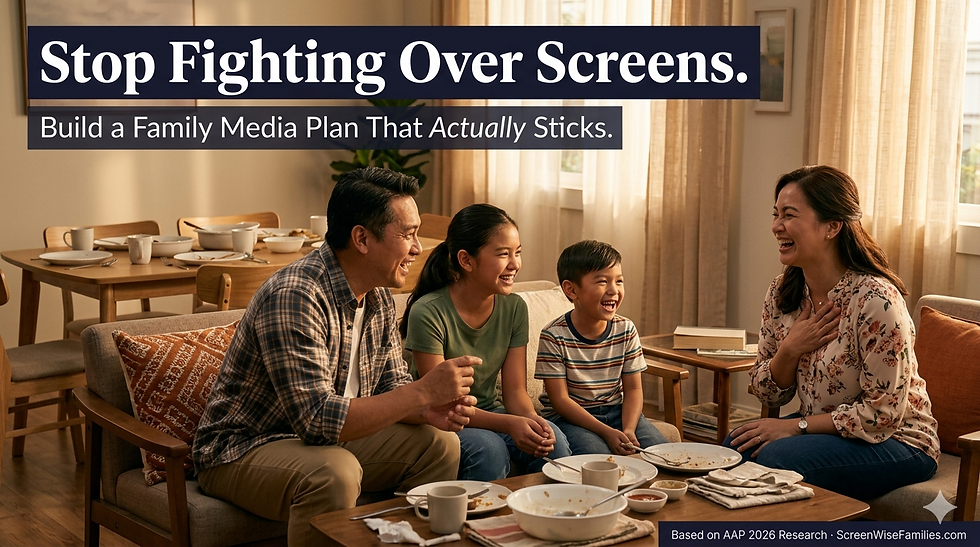
If you've ever found yourself negotiating with a 9-year-old over one more episode, watching your teenager disappear into their phone at dinner, or wondering whether your toddler's screen habits are normal — you're not alone, and you're not failing.
You're parenting in an era that no generation before yours has ever navigated.
The good news: the science has finally caught up. The American Academy of Pediatrics (AAP) released landmark updated guidance in early 2026 — the first major revision in a decade — and the message has fundamentally shifted. It's no longer about counting minutes. It's about something far more achievable: building a family media plan that fits your real life.
What Is a Family Media Plan — and Why Every Family Needs One in 2026
A Family Media Plan is a set of shared, intentional agreements your family makes together about how, when, where, and what kind of media you use. First introduced by the AAP in 2016 and significantly updated in 2022 and 2026, it was built to reflect the reality that screens are now woven into nearly every part of daily life.
Here's what makes a Family Media Plan different from a list of screen rules:
Rules are handed down. Plans are built together.
Rules focus on limits. Plans focus on values.
Rules get broken. Plans get revised.
Research published in Pediatrics, the AAP's flagship journal, found that families who co-create their media agreements — where children have a voice in the conversation — follow through with them more consistently than families who rely on parent-imposed restrictions alone (Moreno et al., 2024).
"The recommendations historically made to parents have become almost impossible"— Dr. Libby Milkovich, Developmental Pediatrician & Co-Author, AAP 2026 Screen Time Report (Coffey, 2026)
The 2026 AAP update removed the old two-hours-per-day limit entirely, replacing it with a nuanced framework built for the actual complexity of modern family life. The goal is no longer compliance with a number. The goal is intentionality — and that's something every family, regardless of resources or circumstances, can work toward.
Why the Old "2-Hour Screen Time Rule" No Longer Works for Kids
For years, the AAP's screen time guidance was simple: no more than two hours per day for children over two, none for children under two. It was easy to remember. It was also, increasingly, disconnected from how families actually live.
The 2-hour rule was built on research about television viewing — a single, relatively passive medium. Today's media landscape is incomparably more complex. A child might spend 20 minutes video-calling a grandparent, 30 minutes on an educational coding app, 15 minutes doing homework research, and 45 minutes watching YouTube — all in a single afternoon. Should those experiences count the same? The answer, according to current research, is clearly no.
What the evidence consistently shows is that the content children consume, the context in which they consume it, and the conversations families have about media matter far more than total minutes on a screen (American Academy of Pediatrics, 2022). The AAP now acknowledges that placing all responsibility on parents — without addressing the broader design of digital environments — isn't fair, and it isn't effective (Coffey, 2026).
The 2026 AAP guidance moves from asking "How long?" to asking "How, what, with whom, and instead of what?" This shift is the entire foundation of the Family Media Plan approach — and it's a far more useful question for real families living real lives.
The AAP's 5 C's Framework: The New Gold Standard for Healthy Screen Time
To replace the blunt instrument of time limits, the AAP's Center of Excellence on Social Media and Youth Mental Health developed the 5 C's framework — a flexible, research-based lens for evaluating any media situation, for any child, at any age (HealthyChildren.org, 2025).
Child
Every child is different. Consider your child's temperament, emotional maturity, vulnerabilities, and strengths — not just their age. A highly sensitive child and a socially confident one may need entirely different approaches to the same content. The 5 C's start with the individual, not a universal standard.
Content
What your child watches, plays, or creates matters enormously. High-quality, age-appropriate, values-aligned content is associated with positive developmental outcomes. Content that models aggression, promotes unrealistic body standards, or is driven by manipulative advertising is associated with negative outcomes. Knowing what your child is consuming is a basic act of digital parenting.
Calm
All children need multiple pathways to manage emotions and wind down. When media becomes a child's only coping strategy — the first and only thing they reach for when bored, anxious, or tired — that's a signal. The goal isn't to eliminate media as a source of comfort; it's to ensure it's one tool among many, alongside physical activity, creative play, and face-to-face connection.
Crowding Out
Rather than asking "how much screen time?", ask: what is screen time replacing? Is it crowding out sleep? Physical activity? Family meals? Face-to-face friendships? Research is clear that these experiences are essential to healthy development. A good media plan protects space for them — not by banning pixels, but by protecting priorities.
Communication
This is the most important C of all. Research consistently identifies open parent-child communication about media as the single strongest predictor of healthy digital habits in children and adolescents (HealthyChildren.org, 2025). Families who talk about media — curiously, honestly, and regularly — produce children with far healthier digital lives than those who rely primarily on rules and restrictions.
Screen Time Guidelines by Age: What the AAP Actually Recommends
One of the most important insights in the updated guidelines is that "children" are not a single category. Here is what current evidence recommends at each developmental stage.
Birth to 18 months: Avoid screens entirely except for video calls with family members. Even background television can distract infants from the face-to-face interaction they need to build language and neural connections (HealthyChildren.org, 2025).
18 months to 2 years: Introduce high-quality programming only — and always with a parent co-viewing. Connect what appears on screen to real-life experiences. No solo viewing at this stage.
2 to 5 years: Up to one hour per day of high-quality, slow-paced educational content, co-viewed with a parent. Protect screen-free routines before meals and bedtime from the very beginning.
5 to 12 years: Set consistent limits that protect sleep, physical activity, and homework time. This is the critical window for building digital literacy — how ads work, how to evaluate sources, and what privacy means. Use parental controls alongside open conversation, not instead of it.
13 to 18 years: No rigid time limit. Shift from enforcement to partnership. Teens need autonomy and trust. Maintain the non-negotiable boundaries supported by strong evidence — particularly devices out of bedrooms overnight — while investing in the relationship that makes everything else possible.
Two boundaries are supported by strong evidence across every age group: no devices at the dinner table and no devices in bedrooms during sleep hours. These are the highest-impact, easiest-to-implement starting points for any family (HealthyChildren.org, 2025).
Social Media and Teen Mental Health: What the Research Really Says
Few topics generate more parental anxiety than social media and adolescent mental health. The headlines are often alarming. The science is more nuanced — and understanding that nuance is what helps you have better, more productive conversations with your teenagers.
Research cited by the AAP shows that approximately 18% of 8- to 12-year-olds and 62% of 13- to 18-year-olds report using social media platforms — including Instagram, Snapchat, Facebook, Discord, and Reddit — every day (HealthyChildren.org, 2026).
Among adolescents and young adults, more than 90% use at least one platform.
Social media is not uniformly harmful. Research documents real benefits: social connection, access to supportive peer communities, creative expression, exposure to diverse perspectives, and civic engagement. The risks are also real: sleep disruption, social comparison, body image concerns, exposure to harmful content, and for some teens, amplification of existing mental health difficulties.
The keyword is amplification. Social media tends to intensify what is already present in a child's life. Teens with strong offline relationships, stable family communication, and good mental health generally navigate social platforms more successfully. Teens who lack these foundations are more vulnerable. The most powerful thing you can do for your teenager's digital life is to strengthen the relationship and the home — not just restrict the app.
The area where research is most unambiguous is sleep. Nighttime device use consistently disrupts adolescent sleep through two mechanisms: screen light suppresses melatonin production, and the emotional stimulation of social media and gaming content activates the nervous system at precisely the wrong moment. Keeping devices out of bedrooms during sleep hours is one of the most evidence-supported recommendations in all of pediatric media research (HealthyChildren.org, 2025).
Why Your Own Screen Habits Are Part of the Family Media Plan
Here is the piece that surprises many parents: the 2022 revision of the AAP Family Media Plan was the first to formally include parents and caregivers as members of the plan. This wasn't an afterthought — it was a research-driven decision.
Studies have identified "technoference" — the interruption of parent-child interaction by a parent's own device use — as a measurable influence on children's emotional engagement, language development, and behavior (Moreno et al., 2024). More than 75% of parents report being active social media users. Children are watching. They are learning.
Including a parent commitment section in your Family Media Plan is the single step most families skip — and the one that matters most for credibility and modeling. When children see the plan applies to everyone at the table, they engage with it as a shared family value rather than a parental imposition.
How to Raise Media-Literate Kids: The Skill That Outlasts Every App Filter
Parental controls and content filters are a useful starting point. They are also, eventually, insufficient. Every child will encounter the unfiltered internet. The question isn't only whether you can protect them today — it's whether you are equipping them to protect themselves tomorrow.
Media literacy — the ability to access, analyze, evaluate, and create media messages — is that protective skill. Research supports media literacy education as a meaningful buffer against harmful media effects across all age groups (HealthyChildren.org, 2025).
Build these five questions into casual, everyday media moments — watching a commercial, seeing a viral post, reading a dramatic headline together:
Who made this — and why?
What techniques are being used to capture and hold my attention?
What values or ideas are being promoted here?
What is left out of this message?
How does this make me feel — and is that feeling being deliberately manufactured?
These questions don't require a formal lesson. Asked consistently over time, they become the internal voice your child carries into every digital space they encounter — long after any filter or parental control has expired.
How to Build a Family Media Plan That Works: A 6-Step Guide
The AAP makes a Family Media Plan tool available at HealthyChildren.org, but the process of building the plan is as important as the product itself. Here is how to approach it effectively.
Step 1: Start with values, not rules. Before discussing screens, discuss what your family values most — sleep, family meals, outdoor time, reading, face-to-face friendships. Let those values drive the plan, rather than starting with "how much is allowed."
Step 2: Involve every family member. Hold a family meeting. Ask everyone — including younger children — what they enjoy about media, what bothers them, and what they think would be fair. Children who contribute to the plan feel ownership over it. Children who feel ownership follow through.
Step 3: Choose screen-free zones, not total bans. The most evidence-supported recommendations are: no devices at the dinner table, no devices in bedrooms overnight, and no screens for at least 30–60 minutes before bed. Start with one before adding more.
Step 4: Address content, not just time. Decide together which platforms, apps, and types of content are appropriate for your home. Review new apps using trusted resources like Common Sense Media. Establish that new accounts and apps require a family conversation before downloading.
Step 5: Write a parent commitment section. This is the step most families skip — and the one that matters most. Write down what you, as a parent, will do differently. Your modeling is more powerful than any rule you write for your children.
Step 6: Schedule a review date. Plans must evolve as children grow. Schedule a family check-in every three to six months. When rules feel outdated or unfair, revising them together is far more effective than simply enforcing them. A plan that gets updated is a plan that stays alive.
Frequently Asked Questions About Screen Time and Family Media Plans
Q: How much screen time should my child have each day?
The AAP no longer recommends a single daily time limit for children over five. Their 2026 guidance emphasizes that the type of content, context of use, and quality of family communication matter far more than raw minutes. For children under 18 months, the recommendation remains to avoid screens except for video calls. For ages 18 months to five years, the recommendation is high-quality content watched with a parent present. The most useful question isn't "how many minutes?" but "what is screen time replacing?" — particularly sleep, physical activity, and face-to-face interaction.
Sources: American Academy of Pediatrics (2022); Coffey (2026)
Q: At what age can my child have their own social media account?
Most major social media platforms set their minimum age at 13, in compliance with the U.S. Children's Online Privacy Protection Act (COPPA). However, having the legal right to create an account is different from being developmentally ready. The AAP recommends evaluating readiness based on the individual child — their emotional maturity, their offline social skills, and the quality of your communication with them about online risks — rather than age alone. Co-creating a clear agreement about how social media will be used before an account is opened is strongly recommended.
Source: HealthyChildren.org (2026)
Q: Is all screen time equally bad for kids?
No. Research consistently distinguishes between different types of media use. Video calls with family members, educational apps, creative media production, and collaborative gaming all have meaningfully different developmental profiles compared to passive, algorithm-driven scrolling or content that models aggression. The AAP's 5 C's framework helps parents evaluate the specific child, the specific content, and the specific context — rather than treating all screen time as equivalent.
Source: HealthyChildren.org (2025)
Q: My teenager ignores every rule I set about phones. What should I do?
Research points consistently toward one answer: shift from rule enforcement to open, genuine conversation. Teens whose parents are curious about their online worlds — who ask questions without judgment and are honest about their own digital habits — are significantly more likely to internalize healthy media behaviors. Consider asking your teenager directly: "If you were in charge of our family's phone rules, what would you actually keep? What would you change?" Then listen. The act of listening is often more powerful than the rule itself.
Sources: HealthyChildren.org (2025); Moreno et al. (2024)
Q: Can too much screen time cause anxiety or ADHD in children?
The research does not support a direct causal link between typical screen time and the development of ADHD. Studies show associations between heavy media use and attention difficulties, but association is not causation — children with underlying attention challenges may be more drawn to highly stimulating media, rather than the reverse. For anxiety, certain types of social media use — particularly passive scrolling and social comparison — are associated with elevated anxiety in adolescents, especially girls. The relationship is bidirectional and highly individual. If you are concerned about your child's mental health, speak with your pediatrician rather than solely adjusting screen time.
Source: HealthyChildren.org (2025)
Q: Should I use parental controls and content filters?
Parental controls are a useful starting point, especially for younger children. However, they are bypassable; they do not teach judgment, and they do not address the emotional and social dimensions of digital life. The AAP recommends using parental controls alongside — not instead of — open communication, media literacy education, and co-viewing. As children grow, the goal should be transitioning from external controls to internal ones. A child who understands why a boundary exists is far more likely to honor it independently than one who simply knows the password is blocked.
Source: HealthyChildren.org (2025)
Q: How does screen time affect children's sleep?
Screen use in the hour before bed — and especially device use in the bedroom after lights out — is reliably associated with delayed sleep onset, reduced sleep quality, and shorter total sleep duration in children and adolescents. The mechanism involves two factors: blue-wavelength light suppresses melatonin, and the emotional stimulation of social media and gaming keeps the brain in an alert state. The AAP's recommendation is unambiguous: all devices should charge outside the bedroom during sleep hours — for children and parents alike.
Source: HealthyChildren.org (2025)
Q: What is "technoference" and does my own phone use affect my kids?
"Technoference" describes the interruption of parent-child interaction by a parent's technology use — checking a phone during feeding, scrolling during playtime, glancing at notifications during a conversation. Research has linked parental technoference to measurable effects on children's emotional regulation, language development, and behavior. It doesn't mean parents must be device-free at all times. It means that certain moments — feeding infants, playing with young children, having real conversations — deserve protected, phone-free attention.
Source: Moreno et al. (2024)
Q: How do I start a family media plan if my kids are already resistant?
Start with one thing, not everything. Families who attempt small, specific changes succeed more often than those who try to overhaul everything at once. Choose the single highest-impact, least-contentious step — most families find that no devices at the dinner table is the easiest entry point — and build from there. Frame it as a family experiment: "Let's try this for two weeks and see how it feels." Children who feel invited into a process are far less resistant than children who feel a rule being imposed on them.
Sources: HealthyChildren.org (2025); StreakFam (2026)
References
American Academy of Pediatrics. (2022). Family media plan. HealthyChildren.org. https://www.healthychildren.org/English/fmp/Pages/MediaPlan.aspx
American Academy of Pediatrics. (2025, January 20). How to make a family media plan. HealthyChildren.org. https://www.healthychildren.org/English/family-life/Media/Pages/How-to-Make-a-Family-Media-Use-Plan.aspx
American Academy of Pediatrics. (2025). Kids & screen time: How to use the 5 C's of media guidance. HealthyChildren.org. https://www.healthychildren.org/English/family-life/Media/Pages/kids-and-screen-time-how-to-use-the-5-cs-of-media-guidance.aspx
American Academy of Pediatrics. (2025). How to build healthy digital habits: 5 tips for families. HealthyChildren.org. https://www.healthychildren.org/English/family-life/Media/Pages/how-to-build-healthy-digital-habits-tips-for-families.aspx
American Academy of Pediatrics. (2025). Media literacy activities for kids & families: Fun ways to promote critical thinking. HealthyChildren.org. https://www.healthychildren.org/English/family-life/Media/Pages/media-literacy-fun-skill-building-activities-for-children-and-families.aspx
American Academy of Pediatrics. (2025). Talking with tweens & teens about media: Conversation starters for parents. HealthyChildren.org. https://www.healthychildren.org/English/family-life/Media/Pages/talking-with-teens-about-media-conversation-starters.aspx
American Academy of Pediatrics. (2026, January 6). Social media & your child's mental health: What the research says. HealthyChildren.org. https://www.healthychildren.org/English/family-life/Media/Pages/social-media-and-your-childs-mental-health-what-research-says.aspx
Coffey, L. (2026, February 5). New AAP 'screen time' recommendations focus less on screens, more on family time. EdSurge. https://www.edsurge.com/news/2026-02-05-new-aap-screen-time-recommendations-focus-less-on-screens-more-on-family-time
Moreno, M. A., Radesky, J., & colleagues. (2024). The family media plan. Pediatrics, 154(6), e2024067417. https://publications.aap.org/pediatrics/article/154/6/e2024067417/199968
Springer Nature. (2024). Media and parenting: Current findings and future directions. In Handbook of parenting and child development (Chap. 52). Springer. https://link.springer.com/chapter/10.1007/978-3-031-69362-5_52
StreakFam. (2026). Family media plan for kids: A research-backed 2026 guide to screen rules that actually stick. https://streakfam.com/blog/family-media-plan-for-kids-a-research-backed-2026-guide-to-screen-rules-that-actually-stick
StreakFam. (2026). Family media plan for kids: A practical, research-backed 2026 guide. https://streakfam.com/blog/family-media-plan-for-kids-a-practical-research-backed-2026-guide
🛒 EXCLUSIVE READER OFFER
You Read the Research. Now Use It.
Screen Wise Families: The Complete Family Media Plan Guide takes everything in this article — every framework, every finding, every age-specific recommendation — and turns it into a working Family Media Plan for your family, in your words, in under an hour.
🔥 LAUNCH SPECIAL — First 15 Buyers Only
25% off — just $3.74 instead of $4.99Use code SCREENWISE25 at Payhip checkout⏰ Ends July 1, 2026 or when the first 15 copies are claimed — whichever comes first
What's Inside:
✅ 7 research-based chapters — ages 0–18, grounded in AAP 2026 guidelines
✅ The 5 C's framework explained in plain language with real examples
✅ An interactive Family Plan Builder — fill it in together and print your family's signed agreement
✅ 27 conversation starters — organized by age group, ready to use tonight
✅ A 90-Day Digital Reset Challenge with a built-in progress tracker
✅ 7 media literacy activities — fun, family-friendly, no prep required
✅ A 10-question knowledge quiz with instant feedback and explanations
✅ A 17-term research glossary in plain parent language
✅ A Bonus Chapter on Digital Wellbeing — habit stacking, Digital Sabbath planner, and wellbeing spectrum tool
📱 Single-file interactive HTML — works on any phone, tablet, or computer. No app. No login. Instant download.
One-time purchase. No subscription. Instant download. Based on AAP peer-reviewed research. Not a substitute for personalized pediatric advice.


Comments