AI and Critical Thinking: How Students Can Use AI Without Losing Their Ability to Think
- Dean Rusk Delicana
- Jun 13
- 6 min read

Introduction
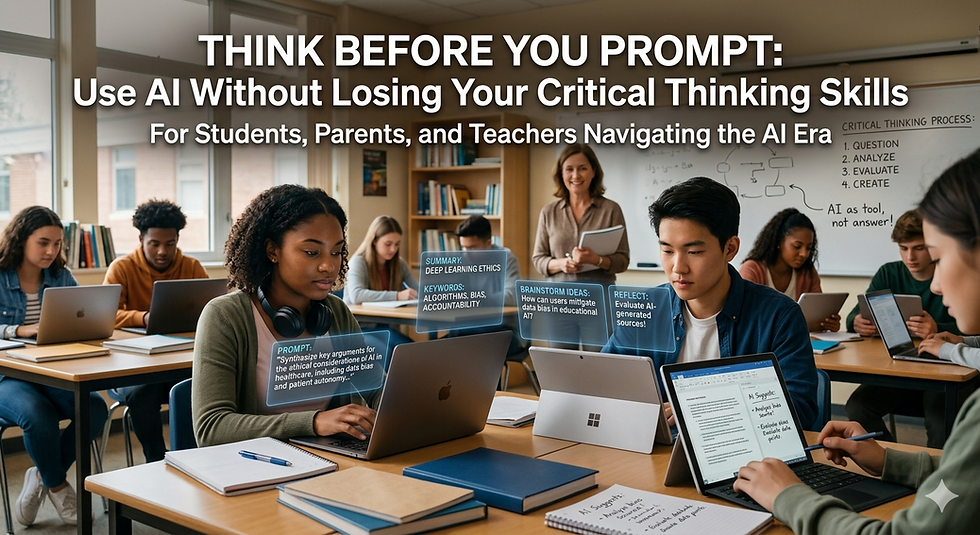
Artificial intelligence has transformed the way students learn. Tools like ChatGPT and educational AI assistants can summarize articles, explain difficult concepts, generate ideas, and even draft essays within seconds.
These technologies offer enormous benefits. However, recent research suggests that the same tools that make learning easier can also weaken some of the very skills education is meant to develop.
Researchers are increasingly asking:
Are students becoming too dependent on AI?
Does AI reduce cognitive effort?
Can excessive AI use damage problem-solving abilities?
How can parents and teachers guide students toward healthy AI habits?
The answer is not to reject AI.
The answer is learning how to use AI wisely.
Why Critical Thinking Matters More Than Ever
Critical thinking is the ability to:
Analyze information.
Evaluate evidence.
Question assumptions.
Solve problems.
Make reasoned decisions.
Reflect on one's own thinking.
These skills are essential not only for academic success but also for future careers and responsible citizenship.
Ironically, the rise of AI makes critical thinking more important—not less.
Students who merely accept AI-generated answers risk becoming passive consumers of information rather than active thinkers.
The Hidden Danger: Cognitive Offloading
Researchers have identified a phenomenon called cognitive offloading.
This occurs when people delegate mental tasks to external tools rather than performing them themselves.
Examples include:
Using GPS instead of remembering directions.
Using calculators for simple arithmetic.
Asking AI to summarize readings without reading them.
While cognitive offloading can save time, excessive dependence may reduce:
Deep understanding
Memory formation
Analytical reasoning
Problem-solving skills
Intellectual confidence
Several recent studies warn that overreliance on AI can lead students to think less and trust machine-generated responses too quickly.
What Research Says About AI and Critical Thinking
1. AI Can Reduce Cognitive Effort
A large survey conducted by Microsoft Research found that knowledge workers often reported exerting less mental effort when using generative AI.
Participants tended to focus more on verifying AI outputs than on generating ideas independently.
This raises concerns that convenience may gradually replace active thinking.
2. Epistemic Laziness Can Develop
Researchers studying university students found that some learners become intellectually passive when using AI.
Instead of investigating information deeply, students may accept answers without questioning:
Accuracy
Sources
Biases
Alternative viewpoints
This tendency is called epistemic laziness.
3. Metacognition Matters
Students who monitor their own thinking processes demonstrate stronger critical thinking when using AI.
Metacognition means asking:
Do I really understand this?
Why is this answer correct?
What assumptions are being made?
Could there be another explanation?
Students who practice reflection are less likely to become dependent on AI.
4. Educational Chatbots Can Support Critical Thinking
Not all findings are negative.
Research on educational chatbots shows that AI can strengthen higher-order thinking when students actively engage with the tool.
Instead of asking AI to provide final answers, students can use it to:
Brainstorm ideas.
Compare perspectives.
Debate arguments.
Evaluate evidence.
Identify weaknesses in reasoning.
In this role, AI becomes a thinking partner rather than a substitute for thinking.
Bloom's Taxonomy and AI
Researchers have revisited Bloom's Taxonomy in the age of generative AI.
AI performs lower-level cognitive tasks remarkably well:
Remembering
Definitions
Facts
Summaries
Understanding
Explanations
Simplifications
Examples
Applying
Basic calculations
Formula usage
Step-by-step procedures
However, higher-order thinking still belongs primarily to humans.
Analyzing
Students must:
Identify patterns.
Compare ideas.
Examine evidence.
Evaluating
Students need to:
Judge credibility.
Detect misinformation.
Weigh competing claims.
Creating
Original insights, creativity, and synthesis remain fundamentally human strengths.
Four AI Habits That Can Damage Critical Thinking
1. Copy-and-Paste Learning
Students ask AI for complete answers and submit them without understanding the material.
Result:
Surface learning with poor retention.
2. Summary Addiction
Students rely exclusively on AI summaries instead of reading original sources.
Result:
Reduced comprehension and weaker analytical abilities.
3. Instant Answer Dependence
Students seek immediate solutions before attempting problems themselves.
Result:
Lower resilience and reduced problem-solving skills.
4. Blind Trust
Students assume AI outputs are always correct.
Result:
Acceptance of misinformation and faulty reasoning.
Healthy Ways to Use AI
Before Prompting
Try solving the problem first.
Ask yourself:
What do I already know?
Where am I confused?
During Prompting
Use AI to:
Explain concepts.
Generate examples.
Challenge assumptions.
Ask questions.
Avoid asking AI to do all the work.
After Prompting
Reflect:
Does this make sense?
Can I explain it in my own words?
Would I arrive at the same conclusion independently?
Advice for Parents
Parents should understand that AI itself is not the enemy.
Instead of banning AI, parents can teach responsible use.
Encourage children to:
Explain AI-generated answers.
Discuss ideas together.
Verify sources.
Think critically about information.
Questions parents can ask:
"Why do you think the AI gave that answer?"
"Do you agree with it?"
"Could there be another perspective?"
These conversations strengthen reasoning skills.
Advice for Teachers
Teachers have a crucial role in preparing students for an AI-rich world.
Effective strategies include:
Designing assignments that require:
Reflection
Argumentation
Source evaluation
Multiple perspectives
Asking students to:
Critique AI responses.
Identify errors.
Compare human and AI reasoning.
Explain their thinking process.
Rather than competing against AI, educators can teach students how to collaborate with it intelligently.
The Goal Is Not Less AI—But Better Thinking
Artificial intelligence is here to stay.
The future belongs not to students who avoid AI, but to students who know how to use AI without surrendering their ability to think.
Critical thinking, curiosity, creativity, and judgment remain uniquely human strengths.
AI should amplify those strengths—not replace them.
Frequently Asked Questions
Should parents prevent their children from using ChatGPT?
No. Research suggests that guided and reflective AI use is more beneficial than prohibition. Parents should teach children how to question and evaluate AI-generated information.
Does AI make students lazy?
Not necessarily. However, excessive dependence may encourage cognitive offloading and reduce active thinking if students use AI as a shortcut rather than a learning tool.
Can AI improve critical thinking?
Yes. Educational chatbots and generative AI can promote higher-order thinking when students actively analyze, question, and evaluate AI outputs.
Should teachers ban AI in school?
Most experts argue against complete bans. Instead, educators should teach AI literacy and develop assignments that emphasize reasoning and reflection.
What skills will become most important in the AI era?
Human skills such as:
Critical thinking
Creativity
Judgment
Communication
Ethical reasoning
Problem-solving
Metacognition
will become increasingly valuable.
Recommended Resource for Students:
Think Before You Prompt: The Student Guide to Using AI Without Losing Your Critical Thinking Skills
Artificial intelligence is an incredible study tool—but only if students know how to use it wisely.
This practical guide helps students develop healthy AI habits while protecting the skills that matter most.
What's Inside
🧠 Chapter 1 – Introduction
Why AI is both the most powerful and most dangerous study tool you've ever had.
📊 Chapter 2 – What's Happening to Your Brain
The science of cognitive offloading and what it costs when AI does your thinking.
🎓 Chapter 3 – Bloom's Taxonomy & AI
Which thinking levels AI handles easily and which ones students must protect.
⚠️ Chapter 4 – The Danger Zone
Four patterns that quietly weaken critical thinking—and how to recognize them.
✅ Chapter 5 – Strategies That Actually Work
Research-based techniques organized into Before, During, and After prompting.
📚 Chapter 6 – Real-World Scenarios
Side-by-side examples of passive versus active AI use.
🧩 Chapter 7 – Self-Check Quiz
Six questions with instant feedback to evaluate your own habits.
📖 Chapter 8 – References
Peer-reviewed sources for deeper learning.
Who Is This Guide For?
Students
Learn how to use AI without becoming dependent on it.
Parents
Help your children develop responsible digital habits.
Teachers
Promote AI literacy and critical thinking in the classroom.
Why This Resource Matters
The future will belong to students who know how to think—not merely how to prompt.
Equip students with the skills they need to thrive in the age of artificial intelligence.
Get your copy here:
References
American Journal of Education and Information Technology. (2025). The impact of AI on students' reading, critical thinking, and problem-solving skills. Science Publishing Group.
Gonsalves, C. (2026). Generative AI's impact on critical thinking: Revisiting Bloom's Taxonomy. Journal of Marketing Education. https://doi.org/10.1177/02734753241305980
Kim, J., et al. (2025). Factors influencing critical thinking during AI use among university students: The mediating effects of epistemic laziness and metacognitive weakness. Current Psychology. https://doi.org/10.1007/s12144-025-08800-0
Lee, H., et al. (2025). The impact of generative AI on critical thinking: Self-reported reductions in cognitive effort and confidence effects from a survey of knowledge workers. Microsoft Research.
Martínez-Maldonado, R., et al. (2025). Artificial intelligence and critical thinking: A case study with educational chatbots. Frontiers in Education, 10. https://doi.org/10.3389/feduc.2025.1630493
Mendoza, J., et al. (2025). Integrating critical thinking and artificial intelligence in higher education: A bibliometric and systematic review of skills and strategies. International Journal of Educational Research Open. https://doi.org/10.1016/j.ijedro.2025.100475
ResearchGate. (2025). AI and critical thinking.
Santoro, A., et al. (2025). AI tools in society: Impacts on cognitive offloading and the future of critical thinking. Societies, 15(1), 6. https://doi.org/10.3390/soc15010006
ERIC. (2025). Artificial intelligence and critical thinking in education.


Comments